
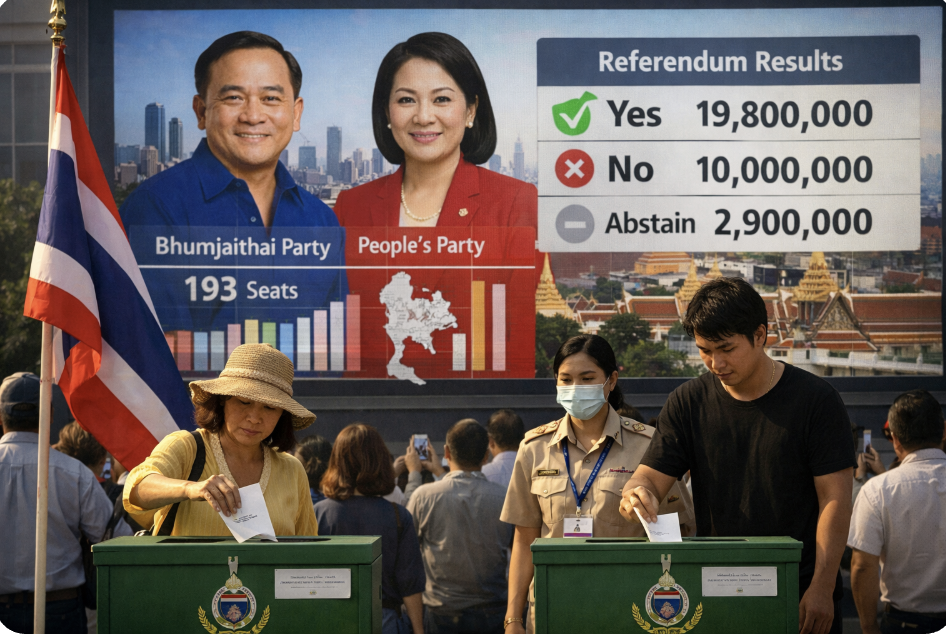
BANGKOK, Thailand – Thailand’s political landscape has entered a new phase following the February 8 parliamentary election and a nationwide referendum on initiating constitutional reform, a vote that revealed both public appetite for change and deep divisions over the country’s political future.
Nearly 19.8 million voters supported beginning the process of amending the constitution, while about 10 million opposed it and 2.9 million abstained, according to official results. The outcome gives reform advocates a symbolic mandate but leaves the scope of any changes uncertain.
The vote provided momentum for the reform-oriented People’s Party, which has long called for sweeping constitutional revisions. Yet the referendum authorized only the start of the reform process; the details of any new constitutional framework will depend largely on the balance of power in Parliament.
Parliamentary Power Favors a Cautious Approach
In the general election held the same day, the Bhumjaithai Party (BJT) emerged as the largest bloc in Thailand’s House of Representatives, securing 193 seats and positioning itself as the most influential actor in the legislative process.
Political analysts say this outcome has created a dual dynamic:
- The People’s Party can claim public backing for reform.
- The Bhumjaithai Party, however, holds the parliamentary leverage needed to shape the speed, scope and procedures of any constitutional changes.
The referendum itself leaves several crucial questions unresolved, including whether Thailand will establish a fully elected constitutional drafting assembly or adopt a hybrid model combining elected and appointed members.
The People’s Party has advocated a comprehensive rewrite of the charter, criticizing provisions related to the role of the Senate and the process for selecting the prime minister. By contrast, Bhumjaithai leader Anutin Charnvirakul has favored a more cautious strategy centered on gradual amendments aimed at preserving political stability.
Institutional Hurdles Could Slow Reform
Any constitutional change faces formidable legislative barriers. Proposed amendments must pass both chambers of Parliament and in many cases require approval from the Senate, which continues to play a pivotal role in the process.
These procedural hurdles mean that reform will likely be shaped less by the referendum’s outcome than by political bargaining and coalition agreements inside Parliament, analysts say.
Regional observers note that Thailand’s constitutional debates have repeatedly been intertwined with broader struggles between reformist forces and conservative political networks that emerged after earlier military interventions in politics.
Coalition Talks Underway
At the same time, negotiations are ongoing to form a new government led by the Bhumjaithai Party.
According to political observers, Mr. Anutin is seeking not only a simple majority but a broad and stable coalitioncapable of governing throughout the parliamentary term.
Reports suggest that the Klatham Party is unlikely to join the coalition formally. Instead, 10 to 20 of its lawmakerscould support a Bhumjaithai-led government from outside the cabinet, a move that could also diminish the influence of the controversial Klatham adviser Capt. Thamanat Prompow.
Another possibility under discussion is the inclusion of the Democrat Party, which holds 22 parliamentary seats. Political scientist Olarn Thinbangtieo of Burapha University has argued that such an alliance could enhance the public credibility and stability of a Bhumjaithai-led government.
The Democrats also retain prominent political figures—including Abhisit Vejjajiva, Korn Chatikavanij, and Karndee Leopairote—whose participation could lend the administration greater policy experience and international confidence.
Internal Party Tensions
Within Bhumjaithai, however, there are signs of hesitation about giving key government positions to smaller coalition partners.
Reports indicate that influential party strategist Newin Chidchob opposes granting major posts—such as the Speaker of Parliament—to a relatively small party like the Democrats. Instead, party leaders are considering assigning the role to a senior Bhumjaithai figure.
For Mr. Anutin, analysts say, the coalition negotiations are about more than simply forming a government. They are part of a broader strategy to build a durable governing bloc capable of limiting the influence of the reform-oriented People’s Party.
The Numbers Behind the Next Government
To return as prime minister, Mr. Anutin needs at least 250 votes in Parliament.
A coalition consisting of Bhumjaithai, Pheu Thai, and several smaller parties could already command roughly 292 seats, according to preliminary projections. With additional support from lawmakers outside the formal coalition, the governing bloc could potentially exceed 300 votes.
Such a majority would provide the government with significant leverage over legislative priorities—including the constitutional reform process.
Reform’s Future: Negotiation Over Mandate
Despite the referendum’s approval of constitutional change, the ultimate direction of reform remains uncertain.
The People’s Party has framed the vote as a victory for democratic reform. But the extent and pace of constitutional amendments will likely depend on parliamentary negotiations and compromises within the emerging governing coalition.
For Thailand, analysts say, the coming months will determine whether the country moves toward substantial institutional transformation or incremental constitutional adjustments—a familiar pattern in the nation’s complex political history.