
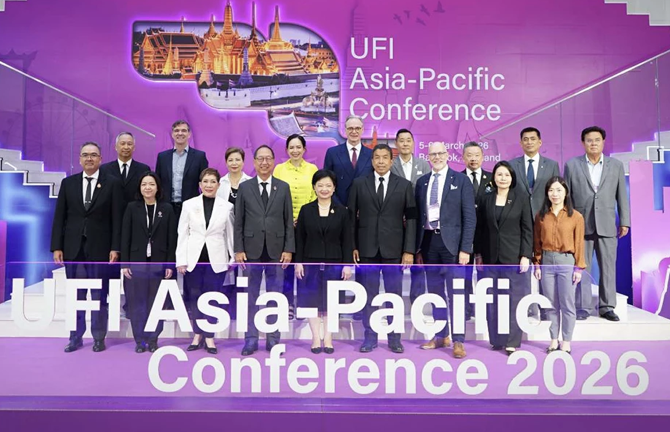
BANGKOK, Thailand — Thailand formally opened the UFI Asia-Pacific Conference 2026 at the Queen Sirikit National Convention Center, bringing together roughly 300 global exhibition industry leaders and reinforcing the country’s ambition to position Bangkok as Southeast Asia’s leading exhibitions and events hub.
The two-day gathering, hosted by the Thailand Convention and Exhibition Bureau (TCEB) from March 5–6, serves both as a global industry forum and a strategic platform for Thailand to promote its “Best Exhibition Nation of ASEAN” branding.
Officials say the exhibition sector is increasingly central to Thailand’s economic strategy, with 165 exhibitions expected nationwide in 2026 generating an estimated 201.45 billion baht ($5.6 billion) in economic activity.
Thailand Seeks Regional Leadership in the Global Exhibition Industry
Dr. Supawan Teerarat, president of TCEB, described the conference as arriving at a “pivotal moment” for Thailand’s exhibitions industry, citing growing international recognition of the country’s infrastructure, public-sector support, and strategic industry planning.
“TCEB has a long-standing relationship with UFI, and we are proud to showcase Thailand’s world-class venues and hospitality,” she said. “Our objective is not simply to attract events based on visitor spending but to generate deeper value through knowledge transfer, innovation, and global industry networks.”
Thailand’s exhibition strategy increasingly focuses on high-value industries, including medical services, advanced manufacturing, automation, and future food systems, aligning the events sector with the country’s broader economic transformation policies.
Industry analysts note that MICE (Meetings, Incentives, Conferences and Exhibitions) tourism has become a significant economic driver across Southeast Asia as governments compete to attract large-scale trade shows and global conferences.
Global Exhibition Industry Faces Transformation
The conference also comes at a moment of rapid change in the international exhibition industry.
Chris Skeith, chief executive of UFI – The Global Association of the Exhibition Industry, said the choice of Bangkok reflects the city’s emergence as one of Asia’s fastest-growing exhibition markets.
“We are delighted to bring the conference back to Bangkok after fifteen years,” Skeith said. “As the industry evolves, discussions here on artificial intelligence, sustainability and shifting global supply chains will help turn today’s challenges into tomorrow’s breakthroughs.”
Across the sector, organizers are adapting to hybrid digital-physical events, sustainability requirements, and supply-chain realignments, trends accelerated by the pandemic and the rise of new regional manufacturing hubs.
According to recent industry reports, the Asia-Pacific exhibition market is expected to grow faster than Europe and North America, driven by expanding trade networks and infrastructure investment across ASEAN.
Major Trade Shows Expected to Boost the Thai Economy
Thailand’s exhibition calendar for 2026 includes several high-profile international events.
Among them are THAIFEX, widely regarded as Asia’s largest food and beverage trade exhibition, and Gastech, one of the world’s leading energy industry conferences, scheduled for September and expected to attract around 50,000 participants.
Officials say 19 new international exhibitions—including events organized by companies from the United Kingdom, Singapore, and China—are set to debut in Thailand this year.
The conference also coincides with Thailand’s growing influence within UFI itself. Panittha Buri, a representative of Thailand’s exhibition sector, currently holds the organization’s presidency, underscoring the country’s expanding leadership role in the global events industry.
ASEAN Competition Intensifies for Global Events
Thailand’s ambitions unfold amid increasing regional competition. Cities such as Singapore, Kuala Lumpur, and Jakarta have also invested heavily in convention centers and international trade events, viewing exhibitions as catalysts for foreign investment, technology exchange, and tourism recovery.
Still, Thai officials argue that Bangkok’s scale, hospitality infrastructure, and strong public-private collaboration give it a competitive advantage.
“Our goal,” Dr. Supawan said, “is to make Thailand a global platform where industries of the future meet, innovate and grow.”
With billions of dollars in projected economic impact and a growing calendar of international exhibitions, Thailand is betting that the events industry will become a cornerstone of its post-pandemic economic strategy and regional leadership ambitions.