
SOUTHEAST ASIA – The escalating conflict involving Iran is rapidly altering the flow of global energy and trade, sending oil and gas prices higher while forcing shipping companies to reroute major cargo lanes that connect Asia and Europe. Analysts warn that if the conflict and related maritime threats persist beyond two weeks, the disruption could ripple across global supply chains, slowing deliveries from Asia to Europe, raising manufacturing costs and creating shortages of key consumer goods.
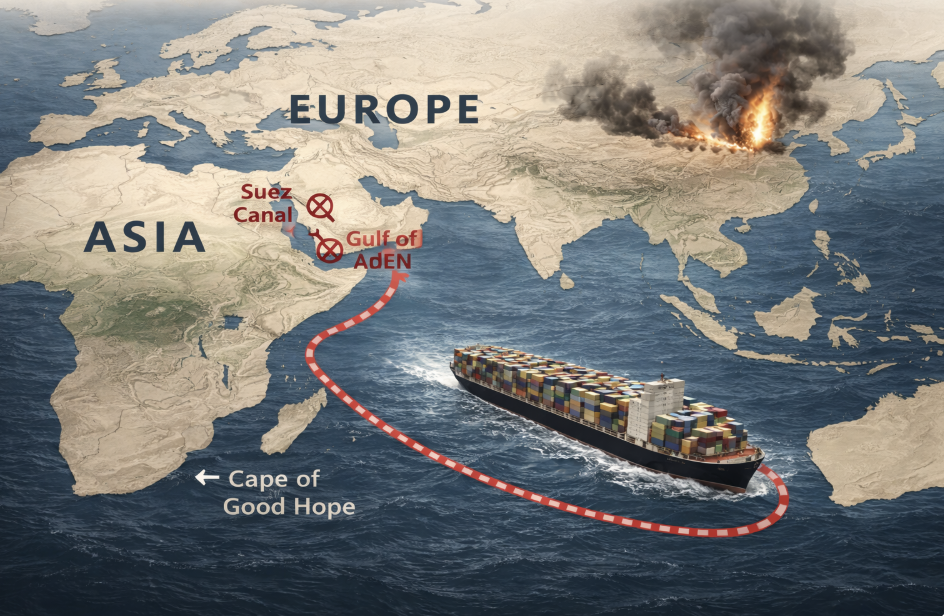
The instability has struck at two of the world’s most critical maritime chokepoints — the Strait of Hormuz and the Gulf of Aden, gateways through which a large share of global energy and container traffic normally flows. As insurers raise risk premiums and shipping companies assess growing security threats, many carriers are increasingly avoiding the Suez Canal route and instead sailing around the Cape of Good Hope, adding weeks to shipping times and significantly increasing costs.
Oil and Gas Markets Hit First
Energy markets reacted immediately. Oil prices surged above $80 per barrel as the conflict disrupted Iranian exports and threatened shipping in the Strait of Hormuz, through which roughly one-fifth of the world’s oil supply typically passes.
Europe, already weakened by the energy shock following Russia’s invasion of Ukraine, faces renewed pressure. Natural gas prices in Europe have jumped roughly 70 percent since the strikes began, raising fears of another industrial energy squeeze. Analysts say European manufacturing, particularly chemicals, metals and heavy industry, remains highly sensitive to sudden energy price increases.
China, the largest importer of Iranian oil, has reportedly instructed its refineries to prioritize domestic supply and suspend some overseas sales. With Iranian exports disrupted, Beijing is expected to increase purchases from Russia and other suppliers.
India is also reconsidering energy sourcing strategies, potentially increasing purchases of Russian gas despite Western sanctions.
Even the United States, the world’s largest oil producer, is unlikely to offset the disruption quickly. American shale producers say expanding production rapidly enough to replace lost supply is not feasible in the short term.
Shipping Routes Between Asia and Europe Under Pressure
Beyond energy markets, global cargo shipping is already showing signs of strain. Major shipping companies have begun imposing emergency surcharges to compensate for longer routes, higher fuel consumption and rising insurance costs.
The primary route linking India, Southeast Asia and East Asia with Europe normally runs through the Indian Ocean, the Gulf of Aden and the Suez Canal. With the region increasingly considered a war zone, many carriers are diverting vessels south around the Cape of Good Hope at the tip of Africa.
This alternative route can add 10 to 15 days to a typical Asia-Europe voyage and increases fuel consumption by thousands of tons per vessel. Freight rates, already volatile since the pandemic, are expected to climb sharply if the conflict persists.
Industry analysts estimate that insurance premiums for ships transiting high-risk areas have already multiplied several times, sometimes adding hundreds of thousands of dollars to the cost of a single voyage.
Impact on Asian Manufacturing
Factories in China, Southeast Asia and India depend on tightly scheduled maritime logistics to deliver products to Europe. Longer shipping routes mean slower container turnover, fewer available vessels and rising freight rates.
If the disruption lasts more than two weeks, analysts expect:
- Shipping costs from Asia to Europe rising 30–50 percent
- Extended transit times of 1–3 weeks
- Port congestion in Asia as containers accumulate
Export-oriented industries such as electronics, machinery, automotive components, textiles and consumer goods would likely feel the impact first.
Manufacturers operating on “just-in-time” supply chains could face delays in both exports and imports of raw materials.
Consequences for Europe’s Consumers and Industry
For European economies, the disruption threatens a combination of energy inflation and delayed imports.
Retailers and importers rely heavily on Asian shipments for products including:
- electronics and appliances
- clothing and footwear
- furniture and household goods
- automotive components
- solar equipment and batteries
If shipping disruptions continue for several weeks, economists expect higher retail prices and sporadic shortages, particularly in seasonal goods and electronics.
European manufacturers may also encounter delays in receiving components from Asian suppliers, potentially slowing production in sectors such as automobiles, machinery and renewable energy equipment.
Potential Product Bottlenecks
Supply chain experts warn that several product categories could face bottlenecks if shipping routes remain disrupted:
1. Electronics and semiconductors
High-value electronics moving from East Asia to Europe rely on frequent container flows.
2. Automotive parts
European car manufacturers depend heavily on Asian components.
3. Consumer goods and textiles
Large volumes shipped from Southeast Asia could face delays.
4. Industrial machinery and batteries
Increasingly important for Europe’s energy transition.
A Two-Week Turning Point
If maritime disruptions persist beyond two weeks, analysts say the situation could escalate into a broader logistics crisis similar to the early stages of the pandemic.
Shipping capacity could tighten globally as vessels take longer routes, pushing freight rates upward across multiple trade lanes. Energy price volatility would further raise transportation costs.
The combined impact — higher fuel prices, longer shipping routes and increased insurance premiums — would likely translate into higher production costs in Asia, delayed deliveries to Europe and rising prices for European consumers.
In the short term, governments and shipping companies are scrambling to stabilize maritime security in the region. But if the conflict continues, the world’s most important trade corridor between Asia and Europe may remain disrupted — with consequences felt across global supply chains.