
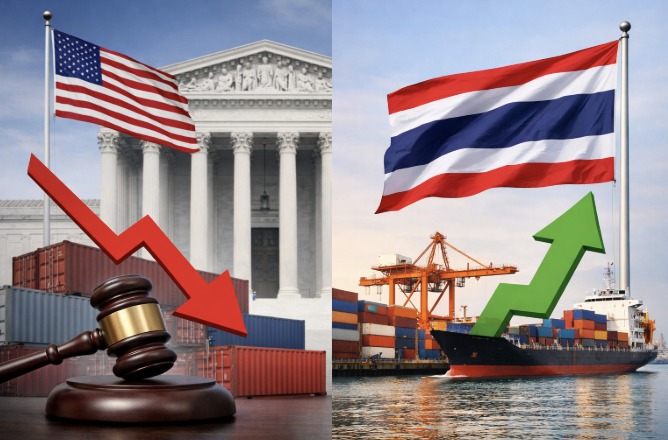
BANGKOK, Thailand – In a decision that reverberated through financial markets from New York to Bangkok, the U.S. Supreme Court on February 20 ruled unlawful former President Donald Trump’s retaliatory tariffs imposed under the International Emergency Economic Powers Act (IEEPA), sharply curtailing the executive branch’s authority to deploy emergency powers in trade policy.
Within days, the White House signaled it would not retreat from its broader tariff agenda. On February 24 at 12:01 a.m., a new 10 percent global tariff took effect under Section 122 of the Trade Act of 1974, following an executive order signed after the ruling. A day earlier, the president had announced plans for a 15 percent tariff rate, calling it legally vetted and permissible, though formal issuance was still pending.
The rapid succession of legal and executive actions has injected fresh uncertainty into global trade flows and financial markets, underscoring the increasingly complex interplay between domestic legal constraints and international economic policy.
Legal Limits, Market Reactions
The Supreme Court’s ruling was widely interpreted in Washington as a significant check on expansive use of emergency powers in trade disputes. Legal scholars described the decision as reinforcing congressional authority over tariff-setting, even as it left alternative statutory tools available to the executive branch.
Markets reacted swiftly. In the United States, equity futures rose modestly on expectations of reduced tariff volatility. In Thailand, the Stock Exchange of Thailand (SET) climbed toward 1,500 points in the days following the decision, buoyed by renewed investor confidence that unilateral U.S. tariff measures would face greater legal scrutiny.
Ekniti Nitithanprapas, Thailand’s deputy prime minister and finance minister, characterized the ruling as a short-term positive signal.
“The United States cannot use tariff tools as conveniently as before,” he said, noting that while trade barriers remain, their form is shifting rather than disappearing.
Thailand had previously faced an effective tariff burden averaging about 19 percent on certain exports. Under the revised U.S. framework, rates of 15 percent — applied for an initial 150-day window — could lower effective duties on some Thai products to below 10 percent, he said. The change also narrows competitive disparities, as countries that previously enjoyed 10 percent rates have seen their tariffs rise to 15 percent.
Southeast Asia Watches Closely
On February 22, Thailand convened an emergency meeting of the Ministry of Finance, Ministry of Commerce, Ministry of Foreign Affairs and the National Economic and Social Development Council to assess implications.
Trade officials expect exporters to accelerate shipments during the 150-day window, particularly in the first two quarters of 2026, to hedge against further policy shifts. Negotiations with the Office of the United States Trade Representative are continuing, Thai officials said, as part of an effort to secure favorable terms and exemptions.
Across Southeast Asia, governments are recalculating. ASEAN’s average tariff exposure currently stands near 19 percent, according to Thai officials, placing the region at the center of shifting supply chains as companies seek stability amid U.S.–China trade tensions.
International analysts note that while the Supreme Court ruling may limit emergency tariff authorities, Washington retains multiple legal pathways to pursue protectionist measures. The result, they say, is not the end of trade confrontation but a recalibration of its mechanisms.
Thailand Accelerates Free Trade Strategy
In response, Thailand is doubling down on free trade agreements (FTAs) to diversify export markets. Goods and services exports account for roughly 70 percent of Thailand’s GDP — 60 percent from goods and 10 percent from services — making trade policy central to economic growth.
Suphajee Suthumpun, the commerce minister, said the government aims to conclude FTA negotiations with South Korea and the European Union in 2026, while advancing agreements with Sri Lanka and the European Free Trade Association (EFTA). Talks on ASEAN–Canada cooperation are also expected to conclude this year.
Officials are reviewing existing FTAs to incorporate digital trade provisions and encourage greater utilization among Thai businesses, where uptake remains below full capacity.
Former Prime Minister Srettha Thavisin cautioned that headline tariff rates of 10 to 15 percent may appear manageable compared with earlier 19 percent baselines, but “conditions and exemptions” could quickly alter competitive balances. He urged a proactive strategy rather than reactive measures.
2026: The “Year of Investment”
Seeking to capitalize on production relocations into Southeast Asia, the Thai government plans to designate 2026 as the “Year of Investment.” Applications for investment promotion at Thailand’s Board of Investment rose 68 percent in 2025 compared with the previous year, reflecting growing interest in Thailand as a regional manufacturing hub.
The prime minister has directed the Council of State to expedite removal of legal bottlenecks and accelerate long-delayed Board of Investment projects. The effort builds on the BOI’s “Fast Pass” initiative introduced in late 2025 to streamline approvals without additional public spending.
Despite momentum, officials acknowledge constraints. The Finance Ministry projects 2026 GDP growth above 2 percent, with an ambitious — though challenging — target of 3 percent. External risks include global financial volatility, geopolitical tensions and evolving U.S. trade policy.
Private Sector: Uncertainty Persists
Thai business leaders warn that the global trade war remains unresolved. Uthai Uthaisangsuk, president of Sansiri Plc, said Thailand needs negotiators who understand comparative impacts across competing economies to preserve long-term competitiveness.
Kessara Thanyalakpark, managing director of Sena Development Plc, cited spillover risks from U.S.–China trade retaliation affecting Thailand’s supply chains and exports.
Buranin Rattanasombat of the Marketing Association of Thailand described the Supreme Court ruling as both reassuring and destabilizing. While it demonstrates institutional checks within the United States, it also highlights policy unpredictability. Thailand, he said, cannot rely solely on the American market and must strengthen domestic demand while expanding into new regions.
Five Structural Risks
Former Prime Minister Srettha outlined five risks confronting Thailand in 2026: elevated household debt, bureaucratic delays, a slowing property sector amid high interest rates, global economic volatility — particularly U.S. trade policy — and the need for domestic political stability to ensure policy continuity.
International observers note that Thailand’s challenge mirrors that of many export-dependent economies: balancing short-term gains from tariff realignment with long-term resilience in an era of fragmented globalization.
The Supreme Court’s ruling may have narrowed one avenue for tariff escalation, but it has not quieted the broader debate over the role of trade policy in economic statecraft. For Thailand and its regional peers, adaptability — rather than certainty — may prove the most valuable asset in the months ahead.