
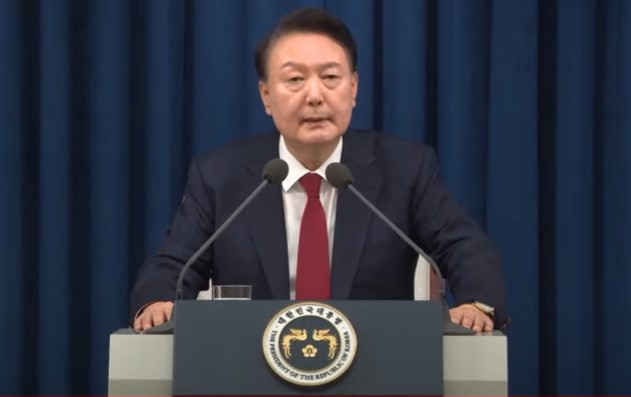
SEOUL — South Korea’s former conservative president, Yoon Suk Yeol, was sentenced to life imprisonment on Thursday after a court found him guilty of leading an insurrection by briefly declaring martial law during a bitter budget dispute in late 2024.
The ruling, delivered by Judge Ji Gwi-yeon at the Seoul Central District Court, marks one of the most dramatic falls from power in South Korea’s modern democratic history. Prosecutors had sought the death penalty, accusing Mr. Yoon of attempting to dismantle constitutional order in pursuit of authoritarian rule.
A Political Crisis Triggered by Martial Law
According to the court, Mr. Yoon declared martial law on Dec. 3, 2024, amid escalating tensions with opposition lawmakers over the national budget. The decree, though short-lived, plunged Asia’s fourth-largest economy into a political crisis and prompted widespread domestic protests and international concern.
Judge Ji said Mr. Yoon ordered troops to the National Assembly building in Seoul in an effort to silence political opponents and “paralyze parliament for a considerable period of time.” The imposition of martial law, the judge added, imposed “enormous social costs” and destabilized public trust in democratic institutions.
“There is little evidence that the defendant has shown remorse,” the judge said in handing down the life sentence.
Prosecutors Cite ‘Ambition for Dictatorship’
In their closing arguments in January, state prosecutors described Mr. Yoon as driven by “a lust for power aimed at dictatorship and long-term rule.” They argued that the temporary suspension of civilian authority and deployment of troops constituted a direct assault on the constitutional order established after decades of authoritarian rule in the 20th century.
South Korea retains capital punishment on the books, though executions have not been carried out in decades. The prosecution’s request for the death penalty underscored the gravity with which the state viewed the charges.
The defense, however, maintained Mr. Yoon’s innocence throughout the trial, arguing that the declaration of martial law was a lawful and temporary emergency measure amid what they described as legislative obstruction by the opposition.
Additional Convictions and Obstruction Charges
The life sentence follows an earlier conviction last month in which Mr. Yoon was sentenced to five years in prison on charges including obstruction of justice. The court found that he had attempted to block investigators from arresting him during the probe into the martial law declaration.
He was also convicted of excluding certain cabinet members from a meeting convened to plan the decree, a move prosecutors said demonstrated intent to bypass institutional safeguards.
Domestic and International Reactions
The verdict has drawn sharp reactions across South Korea’s political spectrum. Leaders of the main opposition party welcomed the ruling as a “necessary defense of democracy,” while some conservative lawmakers criticized it as politically motivated. Civic groups that organized mass protests after the martial law announcement said the judgment reaffirmed the resilience of South Korea’s democratic institutions.
Internationally, governments in Washington, Brussels and Tokyo reiterated their support for South Korea’s constitutional order. The U.S. State Department said in a statement that it respected the independence of South Korea’s judiciary and praised the country’s “commitment to democratic governance and the rule of law.” Analysts in Europe and Asia described the ruling as a significant test of democratic accountability in a region where executive power has often expanded during times of crisis.
A Rare Chapter in Democratic Accountability
South Korea has previously prosecuted and imprisoned former presidents, reflecting a pattern of legal reckoning at the highest levels of power. Yet the conviction of a sitting president for declaring martial law — a measure historically associated with authoritarian regimes — marks a particularly stark episode.
The case has reignited debate over the balance of powers in South Korea’s presidential system and the safeguards designed to prevent executive overreach. Constitutional scholars note that while emergency powers exist, their invocation is tightly constrained by law and subject to parliamentary oversight.
For many South Koreans, the ruling is less about one man than about the durability of institutions forged in the decades since the country’s transition from military dictatorship to democracy.
As the country absorbs the implications of the verdict, the judgment stands as a reminder that even at the highest office, power remains subject to the law.
Photo: REUTERS