
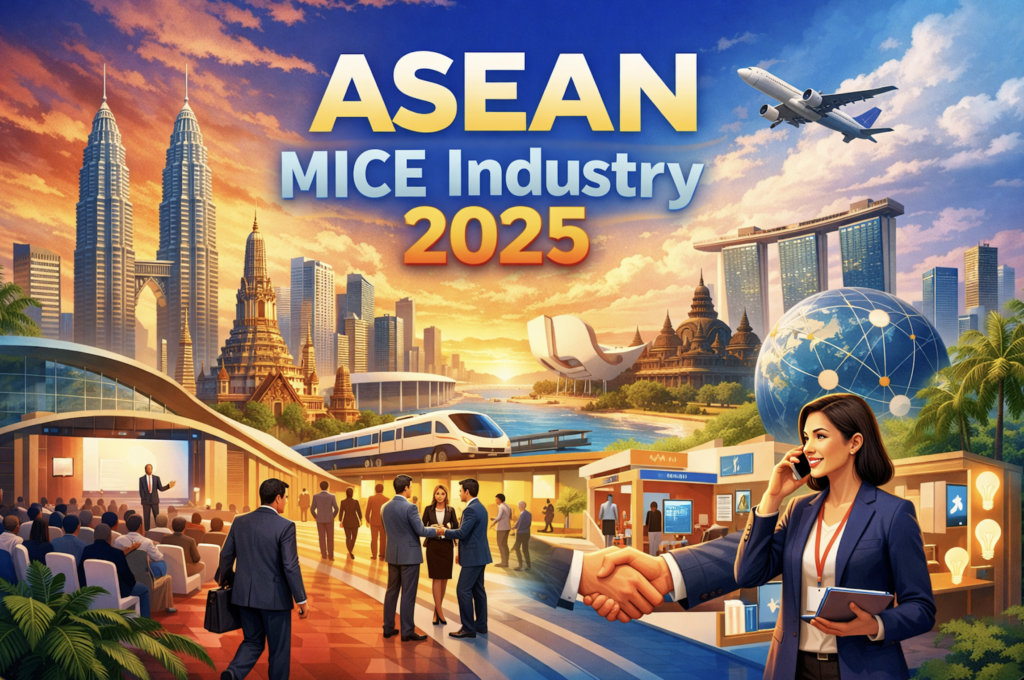
SINGAPORE — As global business travel stabilized in 2025 after years of volatility, Southeast Asia entered a fiercely competitive phase in the race to attract international conferences, conventions and exhibitions. Among the ten member states of the Association of Southeast Asian Nations, two countries clearly separated themselves from the pack: Singapore and Thailand.
Measured by international association meetings — the gold standard of the global MICE industry — Singapore emerged once again as ASEAN’s most successful destination, while Thailand consolidated its position as the region’s largest-volume host.
Together, the two nations captured a majority share of high-profile international congresses held in Southeast Asia, reshaping regional tourism flows and investment priorities.
Singapore: The Global Gold Standard
For Singapore, dominance in international meetings is not accidental. The city-state has spent two decades building what industry analysts describe as the world’s most efficient business-events ecosystem.
In the 2025 cycle, Singapore secured more international association congresses than any other ASEAN country, extending its long-standing leadership in the ICCA global rankings. Its strategy centers on:
- Seamless air connectivity
- Concentrated world-class venues
- Government-backed bid funding
- Aggressive sustainability standards
Unlike leisure tourism, association meetings require years of planning, technical infrastructure, and political credibility. Singapore’s success stems from its ability to reduce risk for organizers, offering predictable operations, regulatory transparency, and medical, financial, and academic depth.
The result: Singapore hosts fewer total events than Thailand but wins the highest-value meetings, including major global medical, engineering, finance, and scientific congresses.
In economic terms, Singapore’s MICE visitors consistently rank among the highest-spending travelers in Asia, producing outsized impact relative to visitor volume.
Thailand: Scale, Diversity, and Global Reach
Where Singapore dominates on precision, Thailand dominates on scale.
In 2025, Thailand hosted the highest total number of international MICE events in ASEAN, anchored by Bangkok’s meteoric rise into the world’s top 10 convention cities.
Bangkok’s competitive advantage lies in:
- Massive venue capacity
- Extensive hotel inventory
- Competitive pricing
- Cultural and leisure appeal
Thailand’s strategy is built around volume and geographic spread. While Bangkok remains the primary hub, cities like Chiang Mai, Phuket, Pattaya, and Khon Kaen are increasingly hosting international meetings.
This distributed model allows Thailand to absorb mega-scale conventions and exhibitions that exceed the spatial capacity of more compact destinations.
The trade-off: Thailand attracts higher delegate volumes, while Singapore captures higher-value meetings per delegate— together forming the twin pillars of ASEAN’s MICE leadership.
Malaysia: The Region’s Most Aggressive Challenger
Malaysia ranked third in ASEAN in 2025, driven by one of the region’s most aggressive government-backed business events strategies.
Kuala Lumpur has positioned itself as a cost-effective alternative to Singapore, offering:
- Large convention infrastructure
- Strong airline connectivity
- Substantial government bidding incentives
Malaysia’s MICE authorities have pursued a global roadshow strategy, particularly targeting European and Middle Eastern associations. The result: steady gains in international congress wins, especially in medical, Islamic finance, and engineering fields.
Industry analysts describe Malaysia as the region’s fastest-closing competitive gap behind the top two.
Indonesia: The Sleeping Giant Awakens
Indonesia’s fourth-place ranking belies its long-term strategic potential.
With Southeast Asia’s largest economy and population, Indonesia is restructuring its MICE sector through:
- A centralized national bidding framework
- Massive venue investments
- Aggressive global branding under “Event by Indonesia”
Jakarta and Bali now increasingly appear in international association bid cycles, while secondary cities such as Surabaya and Medan are entering the MICE ecosystem.
Though still constrained by logistics and regulatory complexity, Indonesia posted one of the fastest MICE growth rates in ASEAN during 2025.
Vietnam and the Philippines: Growth Over Scale
Vietnam and the Philippines ranked fifth and sixth, respectively, but both showed exceptional growth momentum.
Vietnam leveraged its tourism boom and improved air connectivity to convert leisure flows into business-event opportunities, while the Philippines generated record MICE deal volumes, particularly through government-supported trade platforms.
Yet both nations remain constrained by:
- Limited mega-venue infrastructure
- Connectivity bottlenecks
- Inconsistent regulatory environments
These factors cap their ability to compete for mega-scale association congresses, which remain the domain of Singapore, Thailand, and Malaysia.
Why ICCA Meetings Matter
In global MICE rankings, international association meetings are the industry’s most respected benchmark because they reflect:
- Long-term destination trust
- Technical hosting capacity
- Knowledge-industry strength
- Government reliability
Unlike exhibitions or incentive travel — which can shift rapidly — association congresses represent deep-rooted competitiveness, making Singapore and Thailand’s leadership especially significant.
The Strategic Outlook
As Asia’s business travel recovers structurally, ASEAN’s MICE battleground will intensify. Singapore is expected to defend its leadership through technology, sustainability, and knowledge-sector integration, while Thailand continues expanding capacity, geographic spread, and entertainment-driven delegate experiences.
Malaysia and Indonesia remain the region’s most dangerous challengers, capable of reshaping rankings if infrastructure, governance, and connectivity continue improving. (hz)