
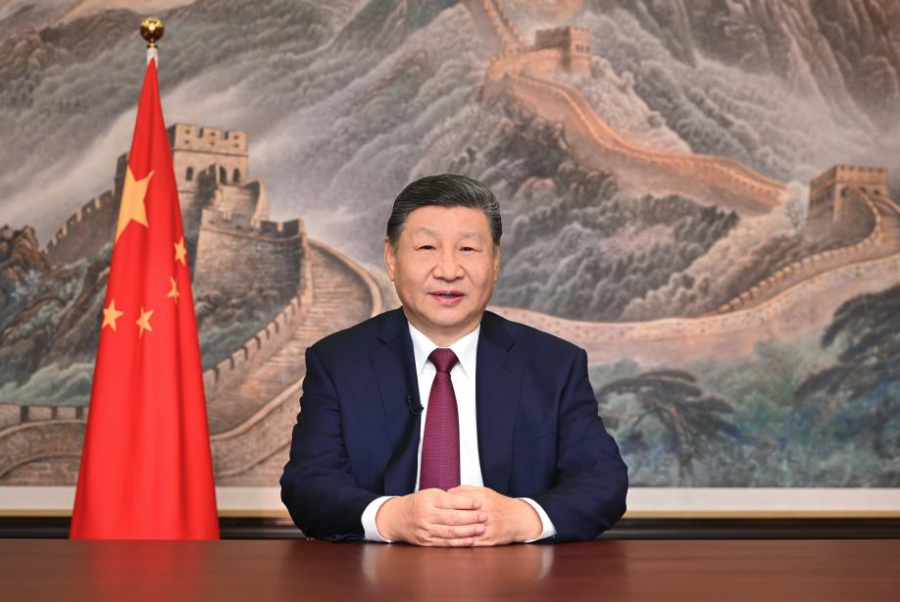
BEIJING – In a nationally broadcast New Year’s address, Xi Jinping, China’s top leader, underscored the country’s technological advances while forcefully reiterating Beijing’s claim over Taiwan, describing reunification as “a trend of the times that cannot be stopped.”
The remarks came days after the Chinese military conducted large-scale exercises around the island, maneuvers that analysts said were widely interpreted as a response to newly approved American arms sales to Taipei. Taiwan, a democratically governed society of 23 million people, is claimed by Beijing as part of its territory. Chinese leaders have repeatedly warned that they reserve the right to use force should peaceful unification efforts fail.
A Message to Taiwan — and the World
In his speech, Mr. Xi portrayed China as standing “on the right side of history,” pledging to work with other nations to promote global peace, development and what he called a more just international order. Yet the emphasis on Taiwan underscored the tension between Beijing’s diplomatic rhetoric and its increasingly assertive actions in the region.
Officials in Taipei responded by reaffirming that Taiwan’s future can only be decided by its people, while urging Beijing to respect the status quo across the Taiwan Strait. In Washington, U.S. officials reiterated their long-standing position of opposing unilateral changes to the status quo, while continuing to support Taiwan’s defensive capabilities under existing security commitments.
Regional observers in Japan and Southeast Asia expressed concern that heightened military activity could raise the risk of miscalculation in one of the world’s most strategically sensitive waterways.
Technology as National Showcase
Mr. Xi also devoted a significant portion of his address to China’s scientific and industrial progress, presenting technological self-reliance as both an economic and strategic imperative. He pointed to intense competition among domestically developed artificial intelligence models, breakthroughs in homegrown semiconductor technology, and advances in humanoid robotics and drone systems.
These claims come as China faces ongoing U.S. and allied export controls aimed at limiting Beijing’s access to advanced chips and manufacturing equipment. Chinese state media have framed recent achievements as evidence that such restrictions have accelerated, rather than slowed, domestic innovation.
Space, Infrastructure and Military Power
Among the year’s accomplishments, Mr. Xi cited the launch of the Tianwen-2 space probe, designed to study asteroids and comets, the start of construction on a major hydropower project in Tibet, and the formal commissioning of China’s first aircraft carrier equipped with an electromagnetic catapult system — a capability previously possessed only by the United States.
Defense analysts say the carrier milestone reflects Beijing’s ambition to project power farther from its shores, even as it reassures neighboring countries that China’s rise will remain peaceful.
Looking Ahead to the Next Plan
Turning to the future, Mr. Xi said China would use the launch of its 15th Five-Year Plan in 2026 to advance further reforms, deepen economic opening and pursue what he described as “high-quality growth.”
For supporters at home, the speech reinforced a narrative of resilience and momentum amid economic headwinds. Abroad, it was read as a reminder that China’s leadership intends to pair technological ambition with a hardening stance on sovereignty — particularly on Taiwan — a combination likely to keep relations with the United States and its allies tense in the years ahead. (zai)
Photo: Xinhua