
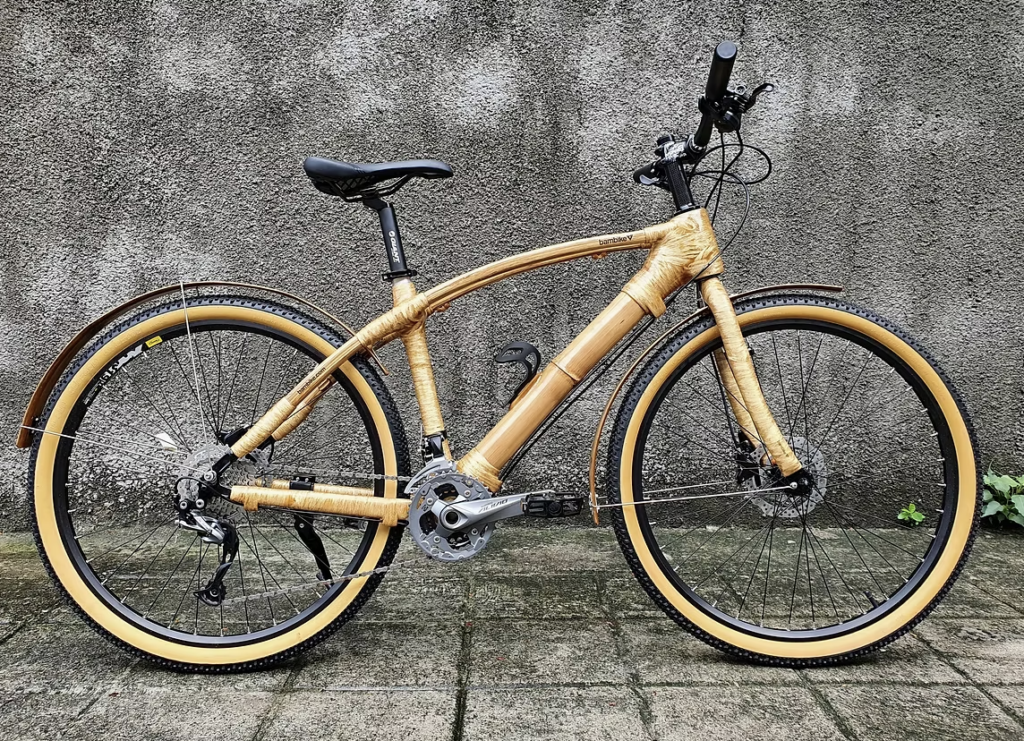
MANILA, Philippines – On a quiet morning inside Intramuros, Manila’s 16th-century walled city, the sound of traffic fades into the background. The cobblestones are uneven, the churches baroque, the walls weathered by centuries of monsoon rains and colonial rule. And gliding past them are bicycles unlike any most visitors have ever seen: frames of polished bamboo, lashed and bonded by hand, light catching on the grain of the wood.
For tourists from Europe—particularly those from cycling cultures like the Netherlands, Denmark, Germany and northern France—this is more than a charming novelty. It is a meeting point of values: mobility, sustainability, craftsmanship and local authenticity. And it has quietly become one of Manila’s most compelling attractions.
A Bicycle Born of Place and Purpose
The bamboo bikes of Manila are best known through Bambike Revolution Cycles, a social enterprise founded around 2010 by Filipino-American entrepreneur Bryan Benitez McClelland. Inspired by bamboo bicycle projects abroad and the Philippines’ own abundance of the fast-growing grass, McClelland envisioned a product that would be at once ecological, local and socially impactful.
Bambike’s frames are handcrafted from Philippine bamboo and reinforced with abaca fiber—another indigenous, renewable material. Each bicycle is assembled by trained artisans known as “Bambuilders,” many of them from communities supported by Gawad Kalinga, one of the country’s most respected social development organizations. Fair wages, skills training and long-term livelihoods are central to the model.
The result is a bike that is not mass-produced but made deliberately—one frame at a time, each with slight variations that speak to the hand that built it.
Why Bamboo Bikes Speak to European Travelers
For visitors from Europe, where cycling is not merely recreational but cultural infrastructure, bamboo bikes tap into a familiar sensibility. Sustainability is not an abstract idea here; it is embodied in motion.
Bamboo, unlike steel or carbon fiber, is rapidly renewable and carbon-negative over its lifecycle. It grows locally, requires minimal industrial processing and has natural shock-absorbing qualities that make it well suited to uneven historic streets like those of Intramuros. The bike becomes a physical narrative of place—Philippine materials, Philippine labor, Philippine design—rather than an imported object dropped into a tourist setting.
This resonates strongly with middle- and northern-European travelers who increasingly seek experiences aligned with eco-conscious travel and ethical consumption. A bamboo bike ride is not just transport; it is participation in a story.
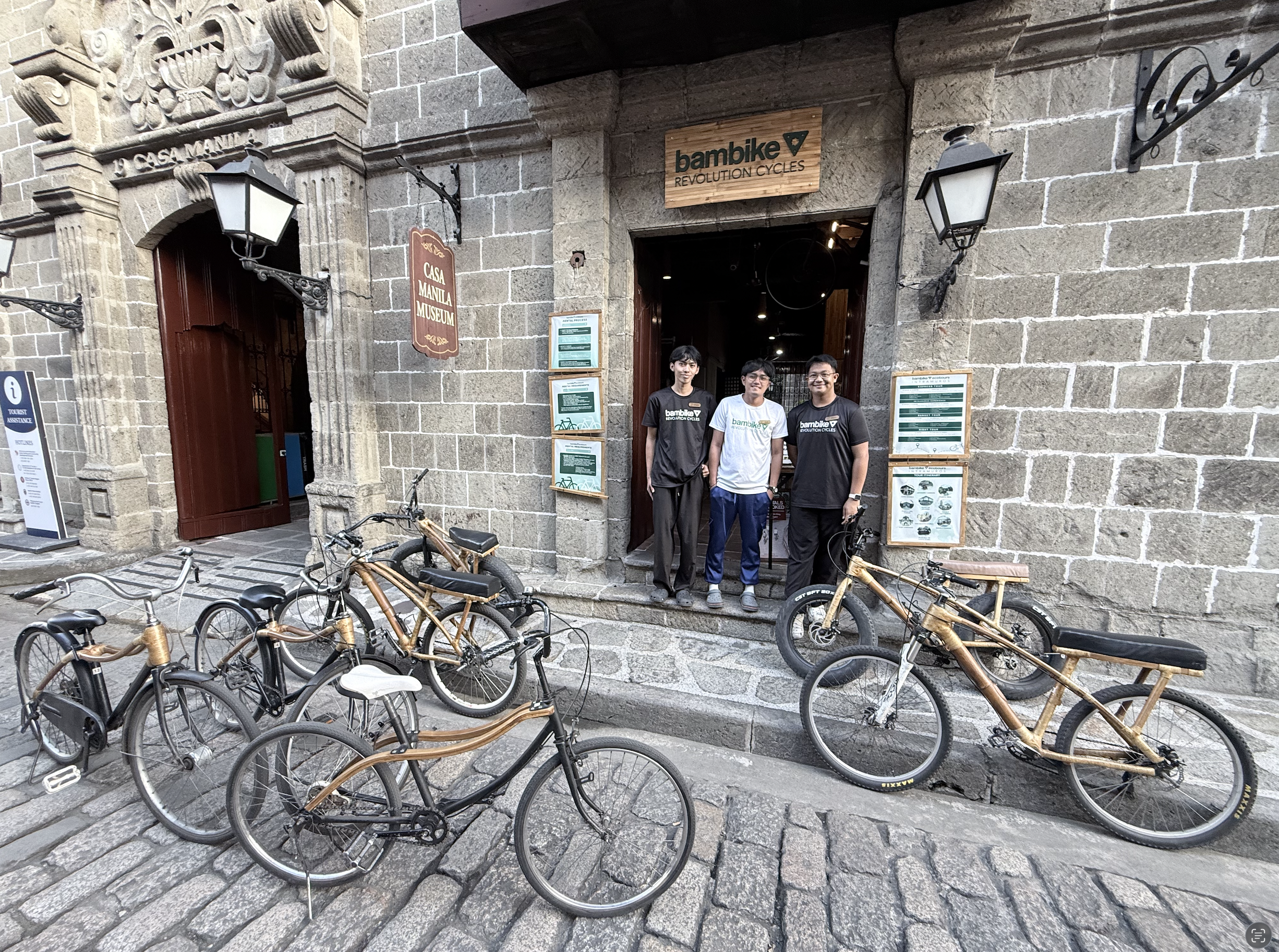
BAMBIKE is located inside Intramural, Manila’s old Spanish quarter
Intramuros by Bamboo: A New Kind of City Tour
Bambike’s most visible success lies in its eco-tours of Intramuros, where visitors rent bamboo bicycles for guided or self-paced rides through the historic district. Churches, plazas and fortifications unfold at cycling speed—faster than walking, slower and more intimate than motorized tours.
For many European tourists, this mirrors how they experience cities at home: upright, observant, environmentally light. Helmets are provided, routes are accessible, and the experience is designed as much for reflection as for movement.
Rental prices are kept accessible for tourists, while the bicycles themselves—when purchased outright—are premium, handcrafted products, often priced far above standard commuter bikes. This dual model allows the enterprise to remain financially viable while keeping the experience open to visitors.
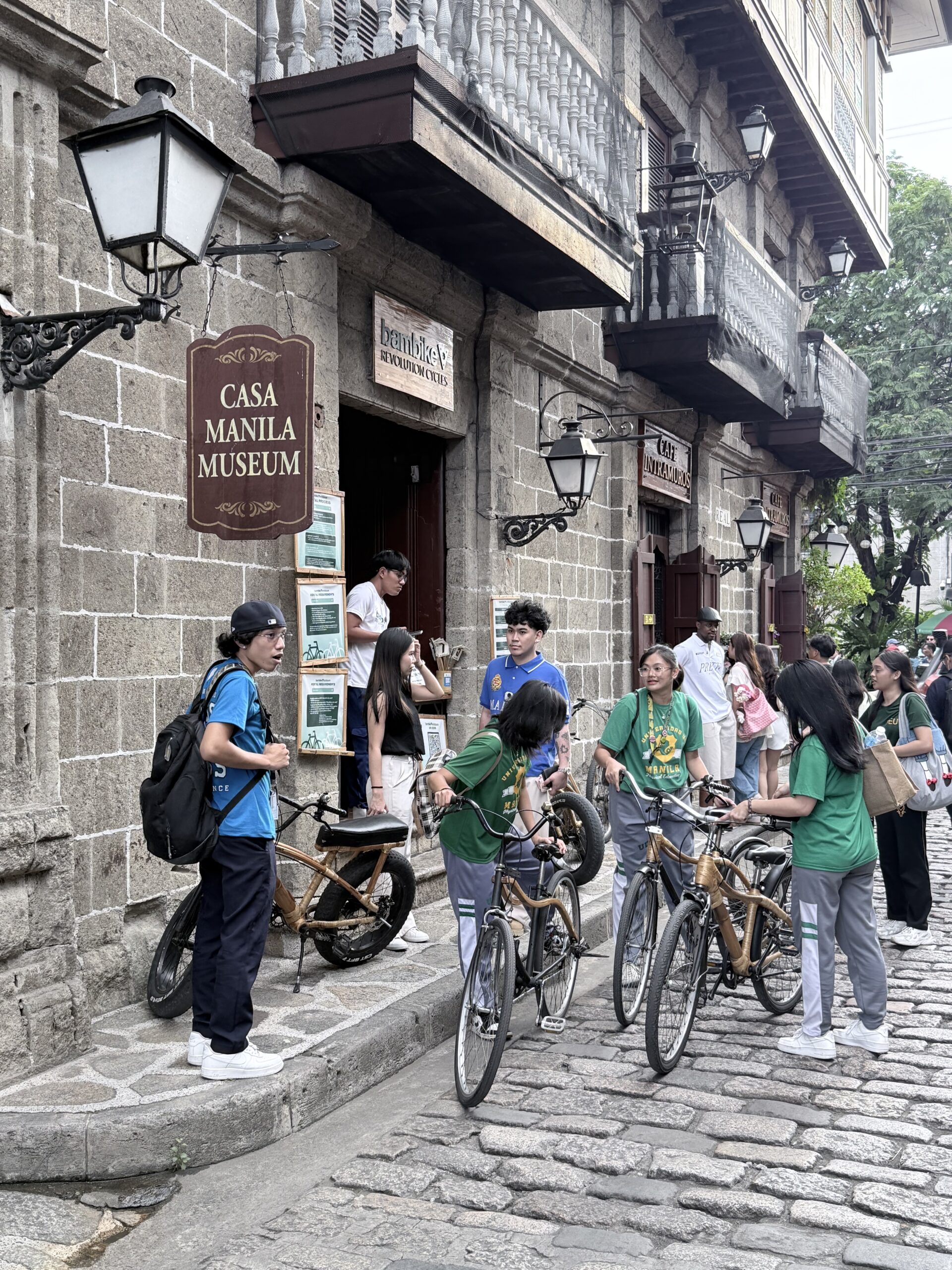
Especially young people like booking Bambikes for joining
a guided tour through the historical neighbourhood
Beyond Manila: A Model with National Reach
While Intramuros remains the flagship location, bamboo bike initiatives have appeared elsewhere in the Philippines, particularly in eco-tourism contexts such as Guimaras and parts of Iloilo. These projects often position bamboo bicycles as symbols of slow travel and rural livelihood, integrating them into local tourism strategies.
For European visitors planning multi-stop Philippine itineraries, bamboo bikes offer a thematic thread—a sustainable way to explore both historic cities and island landscapes.
More Than a Souvenir
What makes bamboo bikes compelling is that they resist being reduced to a gimmick. They are not decorative props but functional vehicles, strong enough for daily use and refined enough to attract international attention. Some have been shipped abroad, where they appeal to design-conscious cyclists willing to pay for sustainability with a story.
In an era when travelers increasingly question the impact of their presence, Bambike and similar enterprises offer a persuasive answer: tourism that moves lightly, pays fairly and leaves skills behind.
Adding a Bamboo Ride to the European Holiday Agenda
For European tourists, especially those accustomed to cycling cultures, a bamboo bike ride in Manila fits naturally into a broader travel philosophy. It pairs well with heritage tourism, culinary exploration and slow travel—without requiring sacrifice or virtue signaling.
It is, quite simply, a good ride.
And in the middle of one of Asia’s most complex megacities, that may be the most unexpected—and most European—pleasure of all. (hz)
Photo: Bambike, AT/hz