
BANGKOK — Days of relentless monsoon rains have unleashed catastrophic floods across Thailand and Indonesia, killing more than 315 people, overwhelming emergency services and submerging entire districts in some of the region’s most densely populated areas, according to local disaster agencies and regional media reports.
Authorities in both countries say the death toll is expected to rise as rescuers struggle to reach isolated communities cut off by washed-out roads, collapsed bridges and landslides.
Thailand: Entire Provinces Underwater
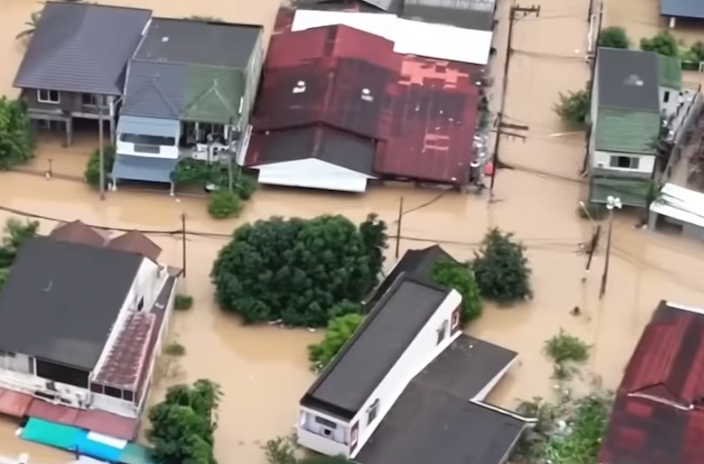
Thailand has faced some of the most severe damage. The Department of Disaster Prevention and Mitigation (DDPM) reported widespread flooding in northern and central provinces after rivers burst their banks, sweeping away homes and inundating farmland.
Thai PBS and Matichon Online reported that rescuers in Chiang Mai and Sukhothai have been working around the clock to evacuate residents trapped on rooftops, with local officials describing the situation as “the worst flooding in over a decade.” In Bangkok, authorities activated additional pumping stations and warned residents along the Chao Phraya River of possible overflow as upstream dams released excess water.
The Bangkok Post noted that several industrial estates north of the capital—critical to Thailand’s export economy—were temporarily shut down amid fears of electrical failures and chemical leaks.
Indonesia: Deadly Landslides and Collapsed Villages
In Indonesia, the National Disaster Mitigation Agency (BNPB) confirmed significant casualties across parts of Sumatra, Java and South Sulawesi. The heaviest toll came from mountainous areas where saturated soil gave way, triggering landslides that buried dozens of homes.
Local outlets such as Kompas, Tempo and Jakarta Post reported that in West Sumatra, rescuers recovered bodies from mud as high as a single-story house, while in Central Java thousands were evacuated from communities where floodwaters reached the rooftops of schools and mosques.
In Jakarta, torrential downpours overwhelmed drainage canals, causing gridlock on major roads and forcing temporary closures of key commuter train lines.
A Regional Crisis With Global Attention
International broadcasters, including Reuters, the BBC and Al Jazeera, said the combined events constitute one of Southeast Asia’s deadliest weather disasters in recent years. Satellite imagery shared by global meteorological agencies on Saturday showed vast swaths of Thailand and Indonesia blanketed by cloud systems linked to an unusually intense monsoon surge over the Gulf of Thailand and the Java Sea.
Climate researchers interviewed by the New York Times International desk and The Guardian said that sea-surface temperatures in the region remain significantly above seasonal norms, amplifying rainfall and increasing the frequency of extreme weather events.
Governments Mobilize, But More Rain Is Forecast
Thailand’s government has deployed thousands of soldiers and volunteers, while Indonesia has activated its national emergency response framework, distributing tents, food supplies and medical assistance.
Still, both disaster agencies have cautioned that conditions could worsen. Meteorological departments in Bangkok and Jakarta forecast more heavy rainfall in the coming days, raising concerns about further landslides and flooding downstream.
Communities Struggle, but Resilience Remains
From the markets of Ayutthaya to the fishing villages of South Sulawesi, communities are now grappling with destroyed homes, polluted water sources and disrupted livelihoods. Yet local media in both nations have highlighted scenes of solidarity: volunteer rescue boats in northern Thailand, neighborhood food kitchens in Java, and farmers forming human chains to retrieve stranded livestock.
As Southeast Asia braces for more rain, emergency responders say the coming 48 to 72 hours will be critical—not only for rescue efforts but for preventing a broader humanitarian crisis across the region. (zai)