
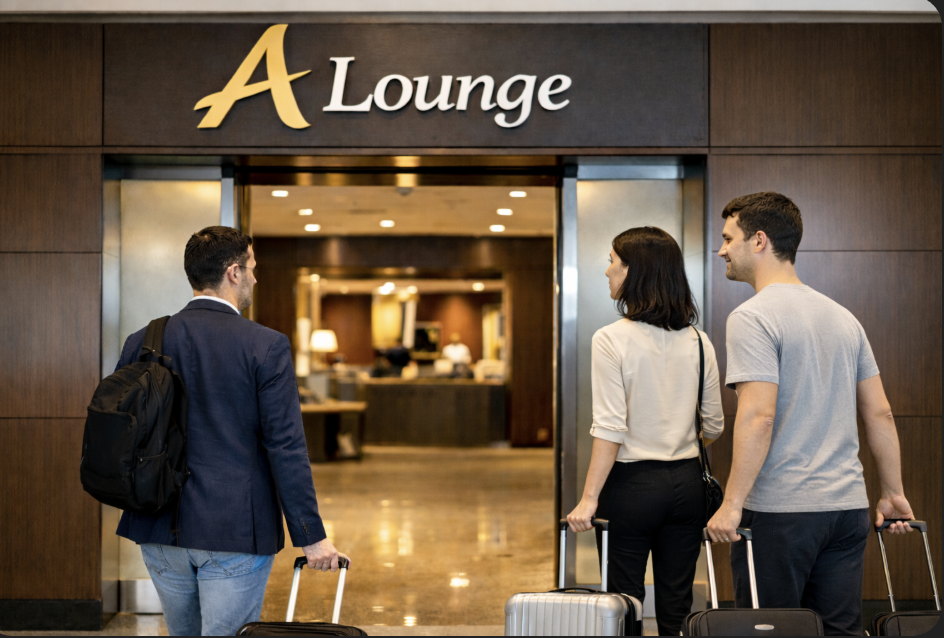
A Traveler’s Report from Asia’s Transit Hubs
For air travelers facing long layovers or awkward gaps between hotel checkout and departure, the promise is seductive: a paid-access airport lounge offering quiet, Wi-Fi, power outlets, snacks and decent coffee. Travel platforms such as Trip.com frequently bundle access to so-called A-Lounges or “VIP airport lounges” as an add-on during flight booking.
But after testing two such lounges in Asia, this writer was left questioning whether the experience justifies the cost—or the effort required to find them.
Who Actually Operates A-Lounges?
A key point often misunderstood by travelers is responsibility. Trip.com and similar booking platforms do not operate airport lounges. They function solely as intermediaries, selling or distributing access—usually via QR code or voucher—to lounges run by third parties.
Airport lounges generally fall into two categories:
- Airline-operated lounges, reserved primarily for first- and business-class passengers or frequent flyers. Examples include premium lounges run by carriers such as Singapore Airlines or Cathay Pacific.
- Independent, pay-per-use lounges, operated by specialized airport service companies and open to the general traveling public for a fee or through access programs.
The latter category includes the A-Lounges discussed here. At Ninoy Aquino International Airport in Manila, A-Lounges in Terminals 1 and 3 are widely understood to be managed by Airport Dimensions, an international lounge management firm operating on behalf of airport authorities or concession holders. Trip.com merely sells the access; service quality lies entirely with the local operator.
Hong Kong: The Lounge That Took an Hour to Find
At Hong Kong International Airport, the experience began with confusion. Signage pointing toward lounges proved contradictory, sending the traveler on long detours across the terminal. Airline lounges were easy enough to locate, but entry was denied—correctly—because paid A-Lounge access does not grant admission to airline-operated facilities.
Requests for directions were met with polite but indifferent shrugs. After more than an hour of walking, the A-Lounge finally came into view—only for it to become clear that time was nearly exhausted. Reaching the departure gate required another 30-minute walk. Even had there been time to linger, the limited food selection offered little incentive.
Manila: Reserved Seats and Bitter Coffee
The situation deteriorated further in Manila. At NAIA, signage again bore little resemblance to reality. Staff at nearby airline lounges appeared unwilling—or unable—to assist, despite the A-Lounge entrance being less than 30 meters away.
Inside, much of the lounge was cordoned off with prominent “Reserved” signs, including the more comfortable chairs and private work cubicles equipped with power outlets. When asked, reception staff offered a brief explanation: the seating was reserved for an unnamed airline client. End of discussion.
The buffet was minimal, and the coffee—advertised as espresso-based—was undrinkable. What emerged from the machine resembled bitter coffee water topped with a few milk bubbles.
A Structural Problem, Not an Isolated One
In theory, independent lounges exist to democratize comfort at airports. In practice, quality varies wildly depending on operator, location and crowding. While global lounge brands such as Plaza Premium Lounge or Aspire Lounges have invested heavily in consistent standards, smaller or concession-based lounges often struggle to deliver a premium experience—especially during peak hours.
The traveler’s frustration here is not aimed at booking platforms like Trip.com, which are transparent about acting only as access sellers. Rather, it highlights a broader issue: the mismatch between marketing promises and on-the-ground reality.
The Verdict
After two disappointing encounters, the conclusion is straightforward. The money spent on paid A-Lounge access would have been better used on a meal of one’s choosing in a public airport restaurant—without the long walks, unclear signage or indifferent service.
It is entirely possible that some A-Lounges, in some airports, provide better value. But based on these experiences, this traveler will no longer chase the promise of tranquility behind frosted glass doors.
It could have been a good experience. Instead, it was a lesson in lowered expectations.