
PHUKET, Thailand — A Panama-flagged cargo ship, the Sealloyd Arc, sank off Phuket’s southern coast on Saturday, Feb. 7, 2026, after taking on water and developing a dangerous list, Thai and international maritime reports said. All 16 crew members were rescued and brought safely ashore, but the incident has triggered an urgent response to a growing oil slick and concerns about container hazards in one of Thailand’s busiest tourism corridors.
A Rapid Deterioration at Sea
According to maritime reporting, the Sealloyd Arc sent a distress call in the afternoon reporting water ingress, with the situation worsening quickly as the vessel listed severely and the crew prepared to abandon ship. The ship later sank at around 9 p.m. local time, several miles (roughly 5 km) off Phuket’s southern shoreline.
Authorities have not publicly finalized a cause, but early accounts center on progressive flooding and loss of stability.
Under the Panama Flag — and Carrying Hazardous Cargo
The Sealloyd Arc was operating under the Panama flag, a registry commonly used in global shipping.
Thai authorities and multiple reports said the ship was carrying hundreds of containers, including 14 listed as hazardous materials. (Container totals vary across official and industry accounts, with figures reported around the high 200s.)
The spill response has been complicated by the risk that floating containers could pose to navigation and by uncertainty over what may have gone down with the wreck.
The Oil Spill Threat: Offshore for Now, but Closely Watched
By Sunday, Feb. 8, an aerial survey detected an oil slick stretching about 4.5 miles (7.2 km) and roughly one mile wide, extending westward — and, crucially for Phuket’s beaches, moving away from the coastline in early assessments. Officials said no oil had reached Phuket’s shore at the time of those updates, but warned conditions could change with wind and currents.
Environmental risk remains significant even when oil stays offshore: slicks can fragment, re-form, and drift unpredictably, threatening nearshore fisheries, coral and seagrass habitats, and tourism-dependent beaches if weather patterns shift.
What the Thai Government Is Doing to Protect the Coast
Thailand’s response has been framed as both an environmental emergency and a maritime safety operation.
A Navy-led command center. The Thai Maritime Enforcement Command Centre (Thai-MECC) established a situation command center — described as a “war room” — to coordinate salvage and containment, invoking legal authority under Thailand’s maritime interests protection law.
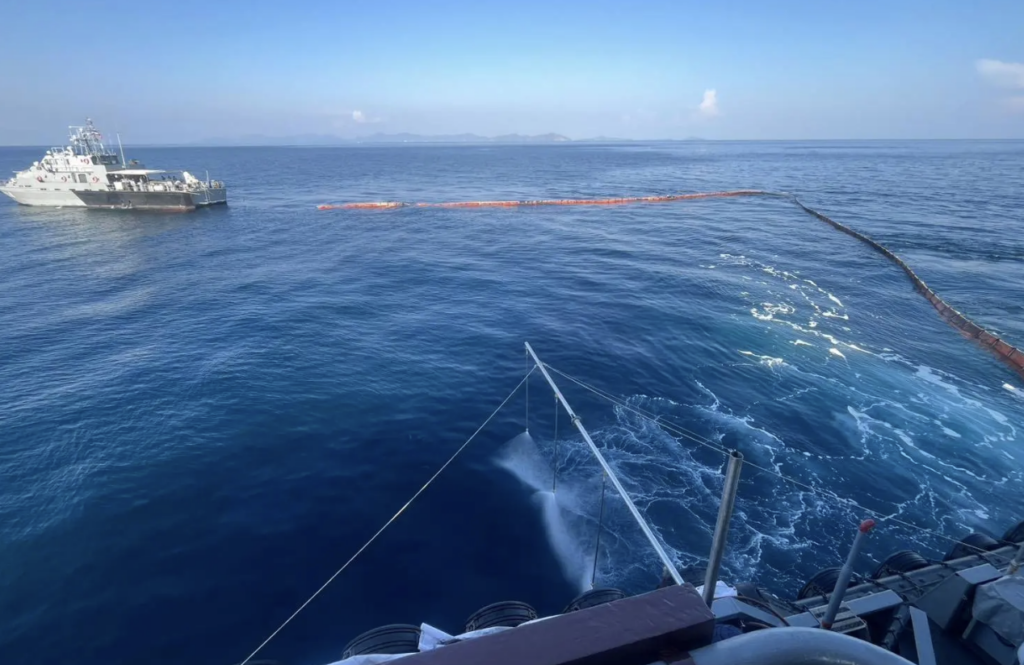
Containment and cleanup at sea. The Royal Thai Navy and partner agencies have deployed vessels and aircraft to monitor the slick and begin containment operations, with response efforts split between oil-spill control and search/recovery of drifting containers.
Navigation warnings. Phuket’s marine authorities issued navigation alerts after containers were reported scattered in the area, reflecting the government’s concern about collisions and secondary accidents in busy Andaman Sea routes.
Salvage planning. Officials have publicly described ongoing planning for salvage operations around the wreck site while continuing surveillance and recovery operations at the surface.
National and International Reaction: Tourism Anxiety, Maritime Scrutiny
In Phuket, the incident has drawn immediate attention because the island is one of Thailand’s most visible tourist destinations, and any shoreline contamination could have outsized economic effects.
Internationally, the sinking has been tracked closely by maritime publications and foreign news outlets, focusing on the Panama registry, the hazardous cargo declarations, and the size of the slick — a reminder of how quickly a regional shipping incident can become a cross-border environmental concern, especially with routes linking Southeast Asia to South Asia.
For Bangladesh, where some coverage highlighted the rescued crew, the episode has been followed as a seafarer safety story as well as an environmental one. (zai)
Photo: Thai government