
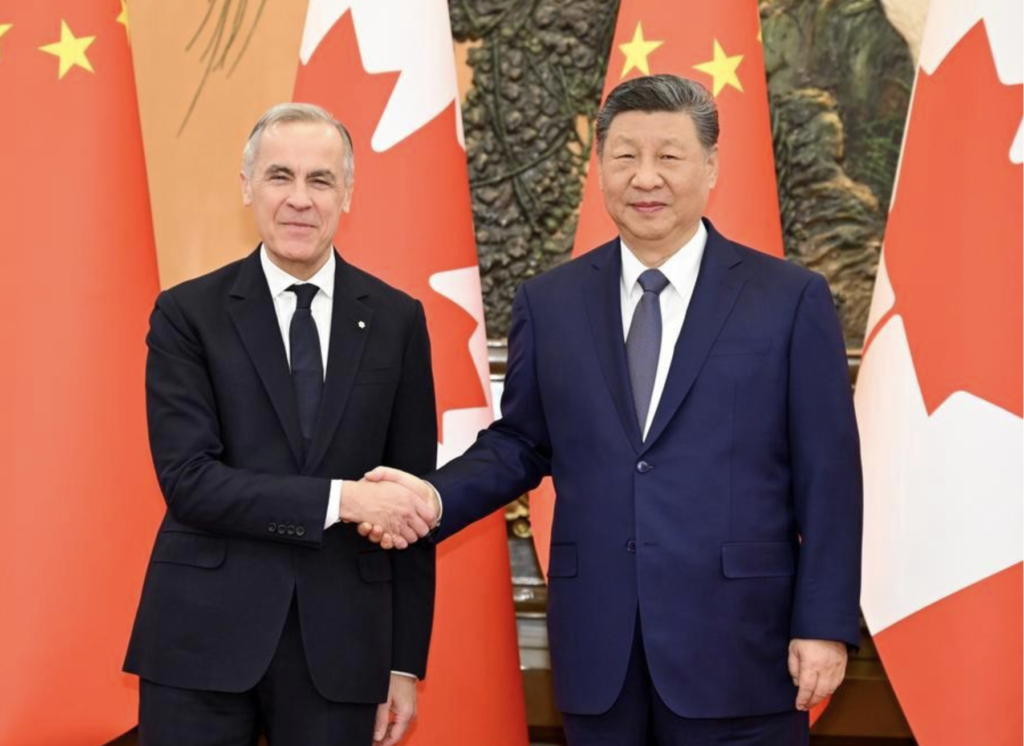
BEIJING — Prime Minister Mark Carney met President Xi Jinping in Beijing on Thursday and announced what both sides described as a new strategic partnership, a bid to stabilize one of Canada’s most consequential and contentious relationships after nearly a decade of strain.
In a joint statement released after the talks, the two governments said China would reduce tariffs on Canadian canola seed, while Canada would open its market to up to 49,000 Chinese-made electric vehicles under a managed import framework. The measures, officials said, are designed to restore trade flows while preserving regulatory oversight and national-security reviews.
A Diplomatic Turn After a Long Freeze
Mr. Carney’s visit capped months of quiet diplomacy following years of chill that began in 2018 with the arrest in Vancouver of a senior executive from Huawei, a case that set off tit-for-tat detentions and trade reprisals. Chinese officials said Thursday that relations had undergone a “turnaround” since the leaders’ first encounter at a multilateral summit last November, calling the Beijing meeting “consequential and historic.”
Canadian officials, speaking on background, said the agreement reflected a recalibration rather than a reversal—aimed at “de-risking without decoupling.” They pointed to guardrails on investment screening, labor and environmental standards, and reciprocal market access as evidence that Ottawa was pursuing engagement on its own terms.
Domestic Reactions: Cautious Optimism and Sharp Questions
In Ottawa, farm groups welcomed relief for canola exporters, a sector hit hard by previous trade barriers. Auto unions and opposition lawmakers, however, urged vigilance over the EV provision, pressing the government to ensure compliance with safety rules and to prevent market distortions. Provincial leaders framed the deal as a test case for balancing growth with industrial policy.
Business groups in Toronto and Vancouver described the accord as a confidence signal, noting that clearer rules could unlock stalled projects in clean energy and critical minerals. Human-rights advocates countered that progress on trade should be matched by sustained dialogue on legal protections and transparency.
International and ASEAN Responses: Watching the Middle Ground
Allies reacted with measured language. European trade officials said the announcement underscored a broader trend of selective engagement with Beijing, while U.S. officials emphasized coordination on standards and security reviews.
Across Southeast Asia, reactions reflected pragmatic interest. Diplomats and analysts in Association of Southeast Asian Nations capitals said the Canada–China reset could ease volatility in global supply chains, particularly for agri-commodities and EV components. Officials in Singapore and Vietnam pointed to potential spillovers in financing and logistics, while Indonesian trade experts cautioned that any surge in Chinese EV exports would intensify competition, accelerating the region’s push for local manufacturing and rules-of-origin safeguards.
What Comes Next
The agreement sets timelines for tariff reductions and a review mechanism for the EV quota, with follow-up working groups on agriculture, climate cooperation and people-to-people exchanges. Whether the reset endures will depend on implementation—and on how both governments navigate domestic skepticism and geopolitical crosswinds.
For now, Thursday’s meeting offered a carefully calibrated thaw: not a return to old assumptions, officials said, but an attempt to move forward with eyes open after years of mutual distrust. (zai)
Photo: Xinhua