
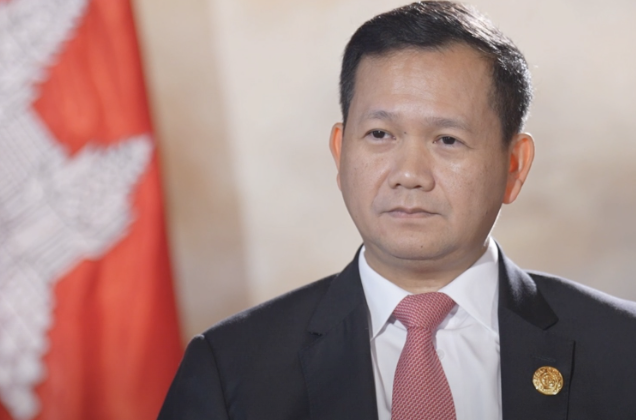
PHNOM PENH, Cambodia — In a rare and closely watched appearance, the Prime Minister of Cambodia delivered an exclusive interview in English to Reuters, speaking directly to a global audience about the ongoing border issue between Cambodia and Thailand.
The interview, conducted in Phnom Penh, marked one of the Prime Minister’s most comprehensive English-language engagements with Western media since taking office. Addressing rising international attention over tensions along sections of the shared frontier, the Prime Minister emphasized diplomacy, adherence to international law and a commitment to peaceful negotiation.
“Cambodia seeks dialogue, not confrontation,” the Prime Minister said during the interview. “We are committed to resolving any differences with Thailand through peaceful means, in accordance with international law and mutual respect.”
A Message Framed for the International Community
Speaking fluently and deliberately, the Prime Minister outlined Cambodia’s historical position on disputed border areas while stressing that sovereignty and stability need not be mutually exclusive. He reiterated that Cambodia supports bilateral mechanisms and regional frameworks to address technical boundary demarcation concerns.
The remarks come amid renewed scrutiny of border management following localized incidents and heightened public discourse in both countries. While tensions have periodically surfaced over the decades, both governments have maintained formal diplomatic relations and economic cooperation.
The Prime Minister underscored that Cambodia values its longstanding relationship with Thailand and its broader role within Southeast Asia.
“Thailand is our neighbor, our partner and a fellow member of the regional community,” he said. “Our peoples are interconnected by history, culture and trade. It is our responsibility as leaders to ensure peace prevails.”
Commitment to ASEAN Principles and International Law
The Prime Minister also referenced Cambodia’s support for the principles of the Association of Southeast Asian Nations (ASEAN), including non-interference, peaceful dispute resolution and regional solidarity.
He affirmed that Cambodia remains open to third-party technical support where appropriate, while maintaining that bilateral dialogue remains the primary channel for resolution.
Legal experts note that previous border disputes in the region have at times involved international arbitration mechanisms, including proceedings at the International Court of Justice. However, the Prime Minister did not indicate any immediate plan to pursue judicial action, instead emphasizing “direct engagement and mutual goodwill.”
Economic Stability and Investor Confidence
Beyond geopolitical considerations, the Prime Minister addressed concerns from international investors and development partners. He assured global markets that Cambodia’s economic fundamentals remain stable and that cross-border trade continues without disruption.
“Cambodia is open for business,” he said. “Peace and stability are at the core of our development strategy.”
Analysts say the decision to conduct the interview in English signals a deliberate effort to communicate Cambodia’s position beyond the region and to reassure international stakeholders amid heightened media attention.
A Diplomatic Tone Amid Regional Sensitivities
Observers described the tone of the interview as measured and diplomatic, reflecting Phnom Penh’s desire to avoid escalation while defending national interests.
While no immediate policy shifts were announced, the Prime Minister’s direct appeal to the international community is likely to shape global perceptions of the dispute in the weeks ahead.
As regional leaders continue consultations, both Cambodia and Thailand face mounting expectations to resolve outstanding border questions through dialogue — reinforcing Southeast Asia’s broader reputation for pragmatic diplomacy and cooperative security.