Tag Archives: Hanoi

US presses Hanoi to reduce dependence on China

WASHINGTON/HANOI –  The US is urging Vietnam to lessen its reliance on Chinese tech in devices assembled locally—such as Apple iPhones, Samsung smartphones, and Meta/Google VR headsets—exported to the American market. Hanoi is hosting meetings with domestic manufacturers to boost local supply chains, yet firms warn they need substantial time and technological investment.

A Washington “tough” position demands a comprehensive overhaul: reducing Chinese component content, curbing origin-label evasion, and expanding US-made inputs.

Tariff Deadline Approaches

The Trump Administration has threatened reciprocal tariffs of up to 46 % on Vietnam-made exports effective July 8 unless Hanoi meets US conditions. Talks, including a third round in Washington from June 9–12, showed promise—but no deal yet.

Vietnam’s Trade Minister Nguyen Hong Dien and US Commerce Secretary Howard Lutnick are scheduled for further virtual negotiations to bridge gaps.

Economic Consequences and Industry Response

Vietnam’s trade surplus with the US swelled to $12.2 b in May—a 42 % year‑on‑year rise—while imports from China reached a post‑pandemic peak of $16.2 b. Last year, Vietnam imported $44 b in tech goods from China (≈30 % of total imports) and exported $33 b to the US (≈28 % of exports).

American firms like Apple, Intel and Nike rely heavily on Vietnam’s “China‑plus‑one” strategy. The American Chamber in Hanoi warns heavy tariffs could damage US investments and bilateral ties (ft.com).

Implementation Barriers

Vietnamese exporters assert that “instant changes would destroy business.” Experts note that building a supply chain of China’s sophistication would take 15–20 years—even if Vietnam is “catching up fast” in areas like electronics and textiles.

Moreover, an accelerated shift risks straining Vietnam–China relations—a complex diplomatic balance given China’s status as both investor and regional power .

Diplomatic Developments

General Secretary Tô Lâm of Vietnam plans to meet President Trump in late June in Washington to advance trade and technology talks, though details are pending confirmation.

Meanwhile, Hanoi has begun cracking down on mislabelled “Made in Vietnam” Chinese imports. It’s also expressed willingness to cut non-tariff barriers and increase US-origin imports—as part of broader concessions.

Vietnam economic growth at stake

With the July 8 deadline approaching, balancing rapid decoupling from Chinese components against preserving export stability and geopolitical relationships poses a significant challenge. Ongoing bilateral talks and high‑level diplomacy will determine whether Vietnam can pivot its tech supply chains swiftly—or face punitive tariffs that could upend its export‑driven growth. (zai)
Vietnam-Thailand: A New Era of Partnership

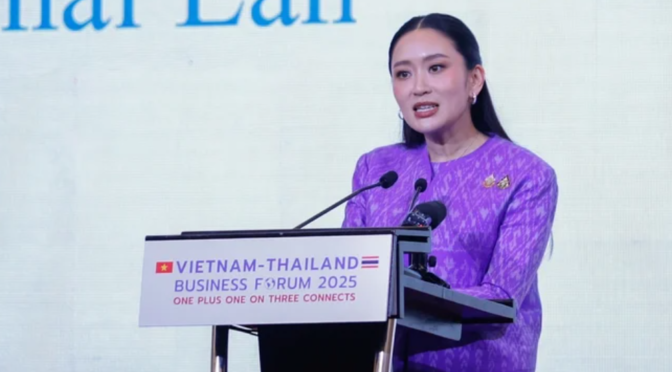
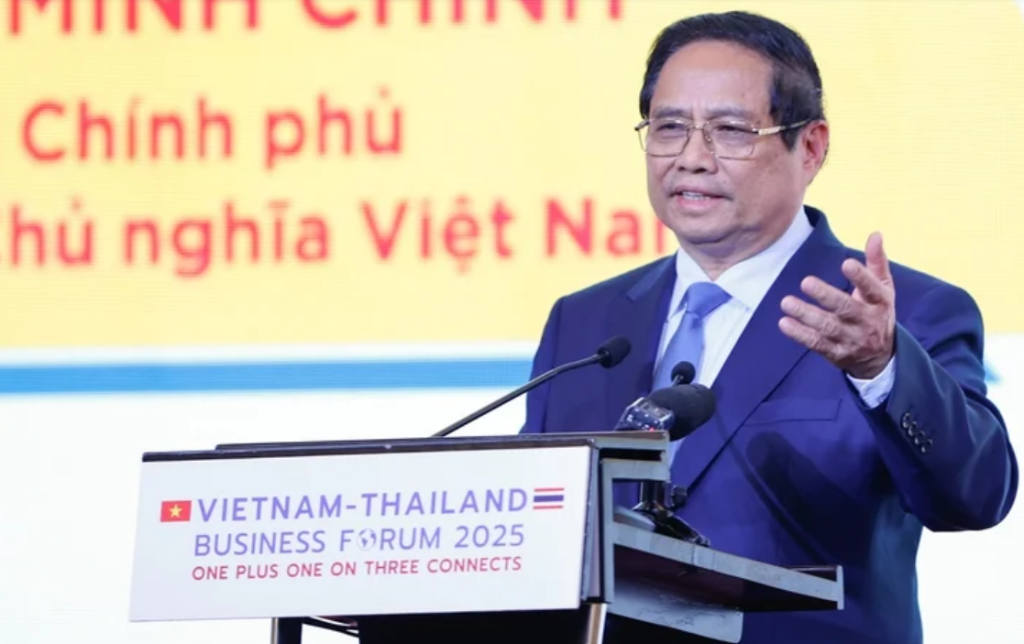
HANOI At the Vietnam-Thailand Business Forum 2025, held on May 16 in the Vietnamese capital under the theme “One Plus One Equals Three Connections,” Prime Minister Pham Minh Chinh and Thai Prime Minister Paetongtarn Shinawatra sent a clear signal of close economic ties between the two countries. The meeting in Hanoi, attended by hundreds of business representatives and leading politicians from both nations, marks a significant milestone in the intensification of their comprehensive strategic partnership.

Strategic Cooperation in Focus

For over 20 years, Thailand and Vietnam have deepened their economic relations, which gained new momentum following the elevation to a strategic partnership in 2015. Today, Thailand is Vietnam’s largest trading partner within ASEAN, with bilateral trade turnover already exceeding USD 21 billion in 2024 – a 6.4% increase compared to the previous year.

Both countries agreed on the ambitious goal of increasing trade turnover to USD 25 billion in the short term. Key areas of focus include the digital economy, green transformation, energy, logistics, semiconductors, and mutual integration into global supply chains.

Triple Strategy for Growth: Supply Chains, Infrastructure, Culture

The “Three Connections Strategy” highlighted at the forum encompasses:

  • Supply Chains: Intensifying business connections, particularly in the areas of digitalization, energy transition, and manufacturing.
  • Transport Infrastructure: Promoting regional corridors such as the East-West Economic Corridor and the Southern Economic Corridor through joint infrastructure projects.
  • Cultural and Economic Connectivity: Expanding education, tourism, and civil society exchange, including new flight connections between Vietnamese cities and Northeast Thailand.
Vietnam Remains a Growth Market for Investors

Prime Minister Pham Minh Chinh affirmed that Vietnam is experiencing stable economic growth despite global uncertainties. With over USD 6.7 billion in realized foreign direct investment in the first four months of the year, Vietnam is one of the most attractive investment destinations in Asia. The country aims for a GDP growth of at least 8% in 2025.

Vietnamese Prime Minister Pham Minh Chinh

Thailand currently ranks 9th among the largest foreign investors in Vietnam, with 767 projects and a total volume of nearly USD 15 billion. Conversely, Vietnamese companies are increasingly investing in Thailand – 22 projects with a capital of around USD 35 million demonstrate this trend.

Future Industries and the Private Sector as Drivers

Both heads of government emphasized the central role of the private sector in bilateral success. Thai companies are expected to support Vietnam in accessing sustainable financing sources and technologies. The focus here is on the green economy, circular economy, renewable energies, digital transformation, and knowledge-based industries.

Both countries see significant cooperation potential, particularly in areas such as AI, semiconductors, petrochemicals, food processing, logistics, and electronic components – also through training programs for the development of highly skilled workers.

New Partnerships and Projects Presented

Several cooperation agreements were concluded at the forum, including:

  • FPT Corporation and Sunline for the digitalization of the Thai financial and retail sectors.
  • Vietjet and Boeing for the delivery of 50 Boeing 737 aircraft for regional tourism traffic.
  • Vietnam Rubber Group and Amata Group for the development of a new industrial park in Dong Nai.
Political Trust and Economic Confidence

Both prime ministers emphasized the strong historical connection between the countries – with President Ho Chi Minh as a symbolic figure. Prime Minister Chinh highlighted that the strategic partnership model with Thailand is exemplary for ASEAN. The joint cabinet structure, initiated by the Shinawatra family, has made cooperation at the government level unique.

Prime Minister Shinawatra concluded: “Thailand and Vietnam are jointly driving the economic growth of the region. Our goal is not only economic success but also a strong foundation for peace, prosperity, and sustainability.”

Conclusion: The 2025 Business Forum has elevated cooperation between Vietnam and Thailand to a new level – as a strategic alliance for growth, innovation, and regional integration in the heart of Southeast Asia. (zai)

Vietnam Signals Readiness for U.S. Trade Deal

HANOI – Vietnam has formally opened trade negotiations with the United States, seeking to avoid a proposed 46% tariff on its exports by demonstrating a willingness to purchase American goods and address long-standing U.S. concerns over trade practices.

The discussions come during a 90-day reprieve granted by Washington, giving both sides a narrow window to reach a deal. Mr. Tran Tuan Anh, head of Vietnam’s trade negotiation team, emphasized the country’s commitment to resolving differences with the U.S. “based on mutual interests,” according to a statement from Vietnam’s Ministry of Industry and Trade.

Vietnam, which in 2024 held the third-largest trade surplus with the U.S.—behind only China and Mexico—has reiterated its pledge to boost imports of American products, including liquefied natural gas and commercial aircraft, while offering to eliminate tariffs on U.S. goods.

As part of this effort, Vietnam Airlines and Vietcombank on April 24 signed a provisional financing agreement to support the purchase of 50 Boeing 737 Max aircraft, reaffirming a commitment first made in 2023. In addition, analysts from Bloomberg Intelligence suggest Vietnam may be preparing to buy Lockheed Martin F-16 fighter jets to replace its aging fleet of Soviet-era SU-22s, a move previously held back due to geopolitical sensitivities with China and Russia.

Vietnam has also taken steps to curb origin-of-goods fraud, a key issue for U.S. trade officials concerned about Chinese goods being rerouted through Vietnam to circumvent tariffs. Prime Minister Pham Minh Chinh reiterated on April 22 that the government is stepping up efforts to combat trade fraud, smuggling, and counterfeit goods, while increasing transparency in customs practices.

The evolving negotiations signal Vietnam’s strategic intent to preserve strong trade ties with the U.S. and maintain access to its largest export market, while deepening its integration into global supply chains and defense partnerships. (zai)

Xi Jinping Visits Vietnam to Deepen Strategic Ties

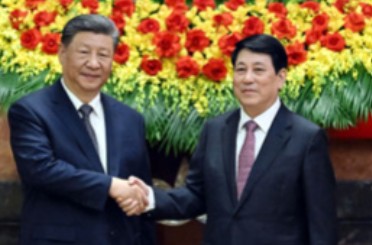
HANOI – Chinese President Xi Jinping arrived in Vietnam on Monday as part of a high-profile Southeast Asia tour aimed at strengthening regional alliances and promoting economic cooperation in response to rising global trade tensions and sweeping U.S. tariffs.

Vietnam is the first stop on Xi’s three-nation tour, which will also take him to Malaysia and Cambodia. The visit is widely seen as part of Beijing’s effort to project itself as a stable and reliable alternative to the United States in the face of growing global uncertainty.

During his visit, President Xi met with top Vietnamese leaders in Hanoi and called for unity in defending multilateral trade, saying both nations must “oppose unilateral bullying and uphold the stability of the global free trade system,” according to Chinese state media. The comment was a veiled reference to recent trade actions by the U.S., including across-the-board tariffs introduced earlier this month.

Strengthening Economic and Security Ties

The visit culminated in the signing of 45 cooperation agreements between China and Vietnam across a broad spectrum of sectors. Key areas of cooperation include:

  • Supply chain integration to bolster economic resilience
  • Joint research in artificial intelligence
  • Expanded maritime patrol coordination, signaling closer security cooperation in the South China Sea
  • Railway and infrastructure development, linking regional trade routes

These agreements reflect Beijing’s strategic pivot toward deeper economic interdependence with ASEAN members at a time when U.S.-China trade tensions are escalating.

Washington Watches Closely

In Washington, the diplomatic move did not go unnoticed. Former President Donald Trump, commenting from the White House lawn, downplayed the meeting but hinted at its implications:

“That’s a lovely meeting… like trying to figure out how do we screw the United States of America.”
He added, “I don’t blame China. I don’t blame Vietnam. I see they’re meeting today, and that’s wonderful.”

Despite his words, analysts say the trip reflects China’s long-term strategy to build influence in the region and create trade alternatives that circumvent American-led systems.

China: Reshaping global trade dynamics

President Xi’s trip to Vietnam, and upcoming stops in Malaysia and Cambodia, underscore China’s intensified efforts to lead in regional diplomacy and reshape global trade dynamics amid increasing economic decoupling between China and the U.S.

As Southeast Asian nations weigh their options in a shifting geopolitical landscape, China’s message is clear: economic partnership with Beijing offers both growth and stability — without the volatility of U.S. domestic politics. (zai)

Photo: Vietnamnet

Vietnam Cuts Tariffs on U.S. Goods to Avoid Penalties

HANOI – In a strategic move to ease trade tensions with Washington, Vietnam has announced significant tariff reductions on key U.S. products, including liquefied natural gas (LNG), automobiles, and ethanol. The cuts aim to address concerns over Vietnam’s growing trade surplus with the United States, which exceeded US$123 billion in 2024.

The Southeast Asian manufacturing hub has taken proactive steps to adjust its trade policies in response to increasing pressure from the Trump administration, which recently expanded tariffs on major trading partners. While Vietnam and the U.S. maintain a Comprehensive Strategic Partnership (CSP), the absence of a formal free trade agreement (FTA) has left Vietnam vulnerable to potential trade restrictions.

Key Tariff Reductions and Their Impact

Nguyen Quoc Hung, head of the Finance Ministry’s tax policy department, announced on March 25 that Vietnam will implement tariff reductions aimed at “improving trade balances with Vietnam’s trade partners.” Among the key changes:

  • LNG tariffs will be reduced from 5% to 2%. While Vietnam has yet to import LNG from the U.S., discussions are ongoing with American suppliers to fuel the country’s upcoming LNG power plants, two of which are set to commence operations by June 2025.
  • Automobile import tariffs will be lowered from their current range of 45% to 64% down to 32%, making U.S. vehicles more competitive in the Vietnamese market.
  • Ethanol tariffs will drop from 10% to 5%, with the complete removal of tariffs on American ethane.

Hung confirmed that a formal decree on the tariff reductions will be finalized within March, with immediate implementation following its approval.

Vietnam’s Broader Strategy to Manage U.S. Trade Relations

Vietnam’s decision to cut tariffs is part of a wider effort to prevent retaliatory trade measures from the U.S., which has been scrutinizing its trading partners for large trade imbalances. To complement the tariff reductions, Vietnam has also undertaken several additional measures:

  • Diversifying imports: The government has encouraged Vietnamese firms to increase the purchase of U.S. agricultural products, technology components, and machinery to offset the imbalance.
  • Boosting U.S. investments in Vietnam: Hanoi has introduced new incentives to attract U.S. companies, particularly in high-tech industries, semiconductor manufacturing, and renewable energy projects.
  • Strengthening compliance with trade regulations: Vietnam has been tightening regulations on transshipment practices to avoid accusations of Chinese goods being routed through Vietnam to evade U.S. tariffs.
Navigating Trade Tensions Without an FTA

Despite being a key U.S. trading partner in ASEAN, Vietnam lacks a formal Free Trade Agreement (FTA) with Washington, making it susceptible to unilateral tariff measures imposed by the U.S. administration. While the Comprehensive Strategic Partnership (CSP) signals deeper cooperation, it does not provide the same level of trade security as an FTA.

As trade relations between the U.S. and China remain tense, Vietnam has benefited as a major alternative manufacturing base for global supply chains. However, the growing trade surplus with the U.S. has put it in a challenging position, prompting Hanoi to take proactive steps to rebalance the economic relationship.

With tariff reductions, increased U.S. imports, and enhanced compliance measures, Vietnam is seeking to maintain its strong economic ties with Washington while mitigating the risks of potential trade restrictions.

Whether these efforts will fully satisfy U.S. trade policymakers remains to be seen, but for now, Vietnam is making calculated moves to secure its place in an increasingly uncertain global trade landscape. (zai)