
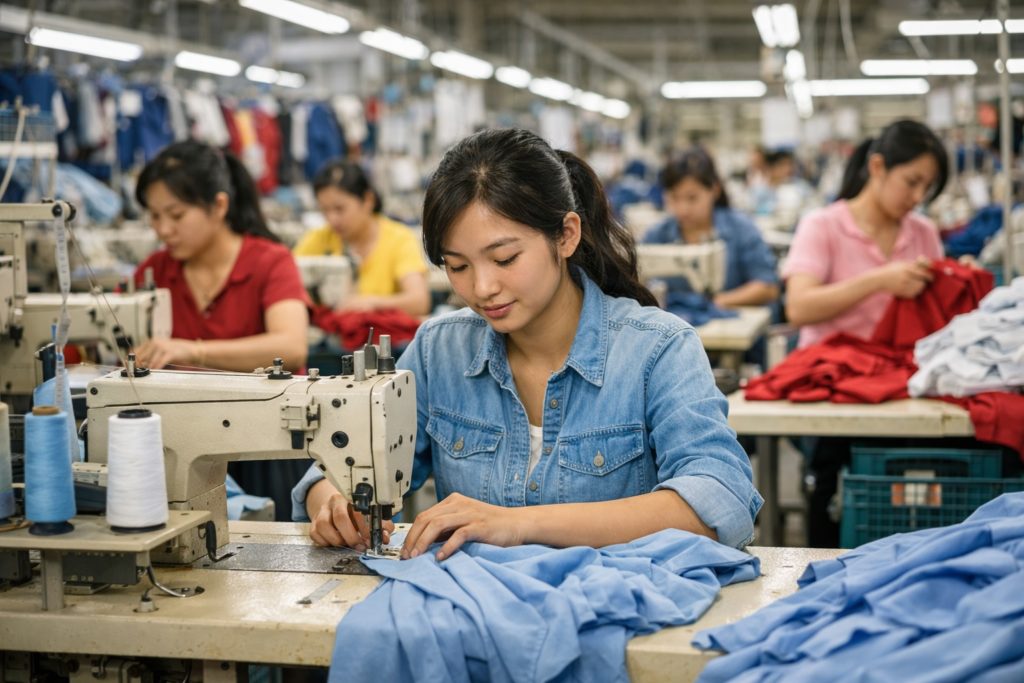
PHNOM PENH — Cambodia’s government is signaling a shift in economic strategy: keep its globally important garment and travel-goods industry competitive, while pulling more Cambodian small and medium enterprises (SMEs) into the supply chains that have long been dominated by foreign-owned exporters. The push amounts to a bet that the country can climb from low-margin assembly work toward deeper, more local production — even as trade rules tighten and competition across Asia intensifies.
A sector that grew fast — and hit its limits
For decades, garments, footwear and travel goods (GFT) have anchored Cambodia’s export economy and employed hundreds of thousands of workers, many of them women. But the government’s own sector strategy acknowledges a stubborn problem: after “three decades,” the industry remains largely low value-added, with limited supporting industries and weak integration beyond the final assembly stage.
Those structural constraints are becoming harder to ignore. The European Union partially withdrew Cambodia’s preferential access under its Everything But Arms scheme in 2020, a step that put duties back on some key exports — including garments, footwear and travel goods — and remains part of the policy backdrop for Phnom Penh’s competitiveness agenda.
The new play: “backward linkages” and SME suppliers
In a January 20, 2026 meeting reported by Cambodia’s state news agency, the Minister of Industry, Science, Technology & Innovation, Hem Vanndy, framed the goal as building “backward linkages” — the upstream supplier base that provides inputs like yarn, accessories, chemicals, leather and packaging — and connecting local micro, small and medium businesses to global supply chains.
The message was echoed by the International Finance Corporation (IFC), part of the World Bank Group, whose Cambodia representative said the institution was exploring investments and support mechanisms tied to green special economic zones, logistics hubs, and financing that could serve both SMEs and larger foreign investors.
Why now: trade shocks, “post-LDC” anxiety and slowing growth
Cambodian officials have increasingly tied the supply-chain push to looming vulnerabilities after the country’s eventual graduation from Least Developed Country status — a change that can reduce trade preferences and raise the stakes for productivity and local value creation.
International economic assessments also underscore the fragility behind headline growth. The IMF said Cambodia’s economy accelerated in 2024 on a rebound in garment exports and a recovery in tourism, but projected growth would ease in 2025 and 2026.
Meanwhile, the sector’s dependence on major markets remains a pressure point. In 2025, Cambodia’s top trade negotiator told Reuters that a newly set U.S. tariff rate helped avert a sharper blow to the country’s garments and footwear industry — a reminder of how exposed the economy is to policy decisions abroad.
What “restructuring” looks like on the ground
The government’s published GFT strategy describes a roadmap aimed at making the industry more resilient, higher value-added, and better integrated into global and regional value chains — including through productivity upgrades, skills development, and stronger coordination across agencies and the private sector.
In practice, officials and development partners describe a near-term focus on turning more Cambodian firms into Tier-2 and Tier-3 suppliers — businesses that can reliably provide components and services to export factories and international buyers — rather than relying almost entirely on imported inputs.
The unresolved question: can local firms scale fast enough?
Cambodia’s own strategy documents concede that prior efforts to build supporting industries have been “limited,” and that the sector still faces constraints in skills, costs and coordination.
The new round of initiatives — backed by ministries, industry players and international financiers — is meant to change that equation. Whether it succeeds may determine if Cambodia can keep its factory economy humming while capturing more of the value it currently imports. (zai)