
CHIANG RAI, Thailand — At the PATA Destination Marketing Forum 2025 (PDMF 2025), held December 1–3, senior officials and tourism leaders from across the Asia-Pacific underscored a decisive shift in global and ASEAN tourism: toward heritage-centered development, wellness-driven travel, and community-anchored economic growth.
The gathering brought more than 320 delegates from 18 destinations to Chiang Rai, a UNESCO Creative City of Design, where three days of talks, technical tours, and community engagement activities offered a window into how policymakers and industry heads envision the future of travel.
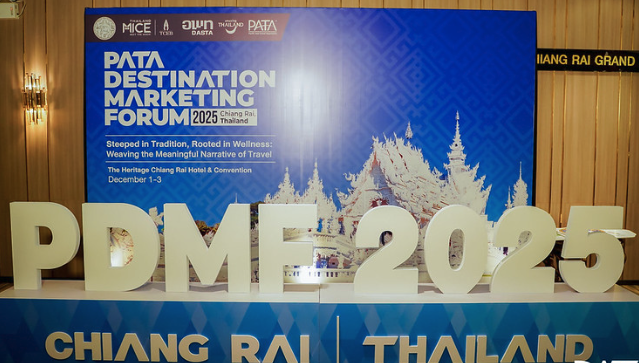
Heritage and Wellness Emerge as Global Priorities
In his opening remarks, Napintorn Srisunpang, Minister Attached to the Thai Prime Minister’s Office, said the forum’s theme — “Steeped in Tradition, Rooted in Wellness” — reflects an increasingly influential direction in global tourism: one rooted in cultural identity and holistic well-being. He argued that this shift is key to building economic resilience across the Asia-Pacific, where countries are searching for models that balance growth with community and environmental stewardship.
“These insights and case studies,” he said, “will inspire new approaches that shape a stronger, more resilient tourism landscape.”
ASEAN’s Secondary Cities Step Into the Spotlight
Speakers repeatedly emphasized the rising importance of secondary and tertiary destinations — a trend accelerating across ASEAN as nations work to decentralize tourism flows.
Peter Semone, PATA Chair, said that destinations like Chiang Rai illustrate how cities outside major capitals can redefine themselves by elevating creativity, establishing a strong sense of place, and empowering local voices in tourism planning. “Its example encourages us to think differently about how destinations can thrive,” he noted.
The forum echoed regional efforts — particularly in Thailand, Vietnam, Malaysia, and Indonesia — to distribute tourism benefits more equitably and reduce pressure on overcrowded hubs.

A New Model for Tourism: Community-Led and Creativity-Driven
Choocheap Pongchai, Governor of Chiang Rai, described his province as “a place full of stories,” linking its appeal to local culture, natural landscapes, and a community-driven concept of wellness. His remarks aligned with a broader ASEAN narrative: that tourism must strengthen, rather than dilute, local identity.
This idea was reinforced by Siripakorn Cheawsamoot, Director-General of DASTA, who highlighted Chiang Rai’s progress in creative tourism and its recognition within the UNESCO Creative Cities Network. International awards for community projects — such as those in Ban San Thang Luang and Ban Pha Mee — were cited as evidence that grassroots initiatives can compete on a global stage.
MICE Industry Seen as a Vehicle for Inclusive Growth
Several speakers stressed the role of MICE (Meetings, Incentives, Conferences, and Exhibitions) tourism in driving sustainable development within ASEAN.
Dr. Supawan Teerarat, President of TCEB, argued that Chiang Rai’s creative-city designation strengthens Thailand’s strategy to position secondary destinations as global MICE hubs. She described MICE as “a powerful platform for sustainable community prosperity,” capable of generating long-term economic opportunities for smaller cities.
Wellness as Southeast Asia’s Competitive Edge
Santi Sawangcharoen of the Tourism Authority of Thailand described the region’s growing advantage in wellness tourism, calling Thailand “a destination where healing is the new luxury.” His remarks emphasized a trend spreading across ASEAN, where countries are marketing cultural depth and natural landscapes as antidotes to the pressures of modern life.
This emphasis reflects a broader global movement: travelers increasingly seek restorative, meaningful, and spiritually grounded experiences — a niche where Southeast Asia is emerging as a leader.

A Regional Outlook Rooted in Balance and Sustainability
Across sessions, the message was consistent: global tourism is undergoing transformation, and ASEAN nations are positioned to lead by embracing sustainability, creativity, and community empowerment.
As PDMF 2025 concluded, it became clear that the future of tourism in the region will depend less on the scale of arrivals and more on the depth of connection — to culture, to place, and to the people who shape it. (Source: PATA)
Photos: PATA