

MEDAN, Indonesia — Days of torrential rain and landslides on the Indonesian island of Sumatra have killed at least 604 people, with 464 others still missing, according to the country’s National Disaster Mitigation Agency, known as BNPB.
The disaster, triggered by Cyclone Senyar and intensified monsoon rains, has torn through three provinces — North Sumatra, West Sumatra and Aceh — submerging villages, shearing away hillsides and forcing more than half a million people from their homes.
Government officials say the operation is now shifting from emergency rescue to recovery, even as thousands of soldiers, police officers and volunteers continue to search for the missing in isolated valleys and along debris-choked rivers.
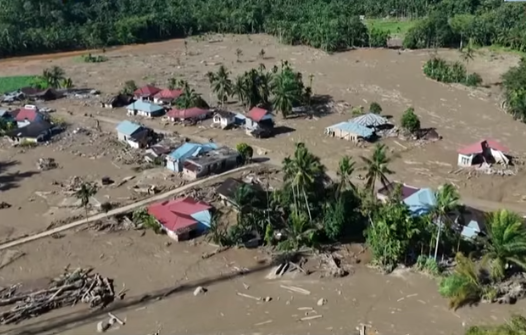
A Race Against Time in Isolated Villages
In many of the worst-hit districts, excavators and rescue dogs are working alongside villagers scraping through mud with shovels and bare hands. Officials in North Sumatra reported at least 166 deaths and 143 people still missing in that province alone, reflecting the scale of devastation in remote upland communities.
BNPB has warned that some areas remain unreachable by road because bridges have collapsed and landslides have buried key routes linking regencies to provincial capitals.
“We are racing against time,” the agency’s chief, Suharyanto, told domestic media, saying that search operations would continue as long as there was any hope of finding survivors alive beneath the rubble or swept downstream.
International wire services, including Reuters and the Associated Press, have documented widespread destruction across northern and western Sumatra, with entire neighborhoods reduced to tangles of concrete, timber and corrugated metal.
Military Ships, Helicopters and Emergency Airlifts
With roads cut off, the Indonesian government has leaned heavily on the armed forces. Three naval vessels loaded with food, medicine and fuel, as well as two hospital ships, have been dispatched to flood-stricken ports, while military helicopters and cargo aircraft are dropping supplies into communities that remain effectively marooned.
President Prabowo Subianto has visited the disaster zone in North Sumatra, pledging to restore critical infrastructure and insisting that aid must reach even the most inaccessible villages.
Indonesia’s state news agency, Antara, reported that the Ministry of Communications is rushing to repair damaged telecommunication towers and restore mobile and internet service, which collapsed in many districts when power lines and fiber-optic cables were washed away.
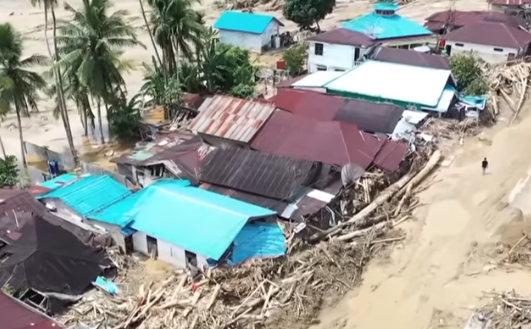
According to data compiled by the ASEAN Coordinating Centre for Humanitarian Assistance on Disaster Management, about 1.5 million people have been affected and roughly 570,000 displaced across the three provinces — figures that underscore the challenge facing local governments as they open temporary shelters and attempt to provide clean water and basic health care.
Domestic Warnings on Land Use, and Global Climate Signals
Indonesian scientists and environmental officials have repeatedly cautioned that unregulated deforestation, hillside farming and mining in Sumatra have made communities more vulnerable to flooding and landslides by stripping away natural barriers that hold back water and soil.
Local outlets such as Tempo and Kompas have highlighted years of land-use disputes in districts now buried in mud, as well as earlier, smaller floods and lahars in West Sumatra that were linked to heavy rain and volcanic debris.
International agencies and climate researchers say the storm that hit Sumatra fits a broader pattern: warmer seas and shifting weather systems are contributing to more intense rainfall events across Southeast Asia.
For now, officials in Jakarta insist their focus is squarely on the immediate emergency — clearing roads, restoring electricity and providing shelter — even as the human toll continues to rise.
“We will rebuild,” Mr. Prabowo said during his visit, according to Indonesian media reports. “But first, we must make sure every survivor is found and every family receives help.” (zai)