
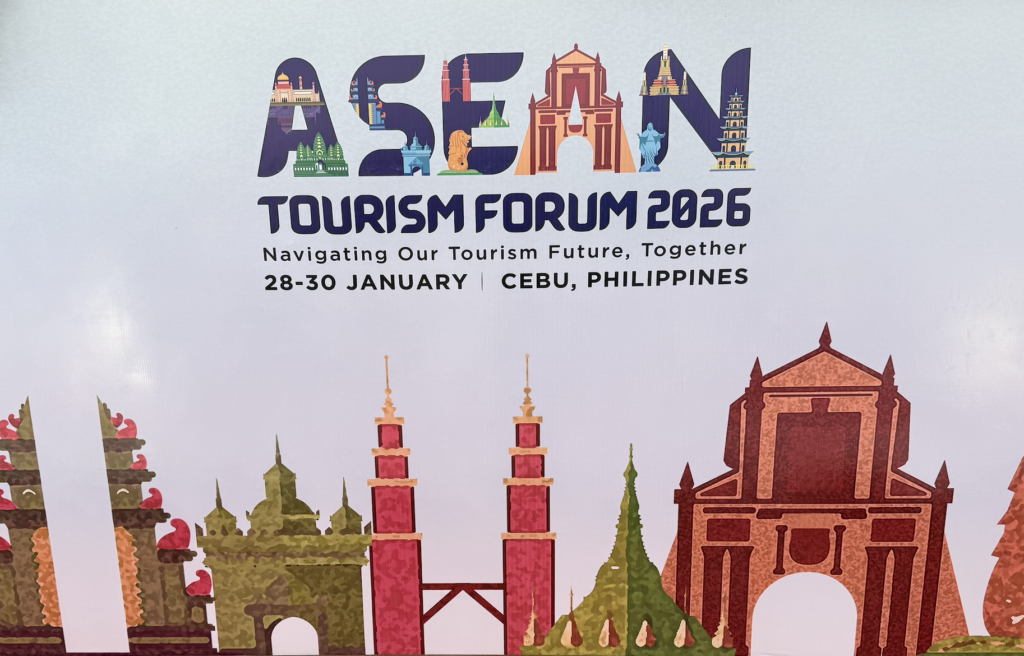
CEBU, Philippines — On a warm January evening on Mactan Island, where a seaside monument commemorates one of the Philippines’ most enduring stories of resistance, tourism officials from across Southeast Asia gathered to open the ASEAN Tourism Forum (ATF) 2026 with a message that was equal parts welcome and warning: the region’s travel boom is back, but its future will depend on coordination.
The official opening ceremony, held Jan. 28 at the historic Mactan Shrine in Lapu-Lapu City, leaned heavily into Filipino cultural heritage — indigenous performances, music and a formal gong-sounding led by Tourism Secretary Christina Garcia Frasco alongside visiting tourism ministers.
Behind the choreography was the forum’s governing idea, repeated in speeches and briefings throughout the week: “Navigating Our Tourism Future, Together.” It is a slogan that nods to shared geography — thousands of islands and coastlines — and to shared pressures: climate risk, digital disruption, overtourism in hotspots, and the scramble for travelers from China, India, Europe and North America.
A Host City, and a Host Country, Making a Strategic Play
Philippine officials have framed ATF 2026 as an early showcase of the country’s ASEAN chairmanship — and a bid to spread tourism growth beyond Manila by putting Cebu and nearby destinations at the center of the region’s travel diplomacy. SunStar reported that about 5,000 delegates were expected, including tourism ministers, senior officials and private-sector leaders, with visitors also anticipated from partner markets like Japan, South Korea, India, Australia and others.
In the government’s account of the opening, Ms. Frasco read a prepared speech on behalf of President Ferdinand R. Marcos Jr., telling delegates that the Philippines would steer its chairmanship with “humility and resolve” and push for “shared growth.”
An international travel trade outlet, TravelMole, emphasized the same point: the President’s message was delivered by Ms. Frasco because he was engaged elsewhere, but the administration’s framing was clear — tourism as a regional economic engine and a political bridge.
The Business Engine: TRAVEX Opens in a New Venue
If the opening ceremony was symbolism, TRAVEX — the ASEAN Travel Exchange — was commerce.
The Philippine Information Agency (PIA) said TRAVEX 2026 opened the same day at the newly inaugurated Mactan Expo Center, drawing 271 buyers from 50 countries, along with 124 Philippine sellers and 222 ASEAN exhibitors.
Tourismag, a Europe-based industry publication covering the event, described the expo center as the site of its first major international exhibition, positioning Cebu as an emerging M.I.C.E. (meetings, incentives, conferences and exhibitions) hub. It also published its own count of TRAVEX participation — including hundreds of exhibiting delegates and booths — and pointed to a broader international media presence.
Official ATF materials list TRAVEX as running Jan. 28 to 30, 2026 in Mactan, Cebu, underscoring the forum’s dual identity: part ministerial summit, part marketplace.
A Road Map for 2026–2030, and the Hard Problem of “Together”
The week’s policy centerpiece is the region’s tourism blueprint for the next phase: the ASEAN Tourism Sectoral Plan (2026–2030), described by Philippine organizers as a framework for making tourism more sustainable, inclusive and resilient, while keeping ASEAN competitive.
In Cebu, the plan’s language collided with an on-the-ground reality familiar to many destinations: travelers are returning quickly, infrastructure and ecosystems recover slowly, and local communities often feel the strain first.
The opening night attempted to reconcile those tensions through narrative. Performers traced Cebu’s past — early maritime links across Southeast Asia, the blending of traditional and modern forms — and ended with a unity song invoking modern heroism. In the government’s telling, it was a reminder that tourism, at its best, is not only an industry but also a cultural exchange.
Yet the week’s theme — navigating together — also suggested the risk: without shared standards and cooperation, ASEAN’s travel rebound could become a contest among neighbors rather than a collective rise. And that would be a very different journey from the one Cebu’s opening ceremony tried to stage. (hz)